What Makes Us Slaves to Our Possessions?
Humans are social animals. Therefore, one of humanity's fundamental needs is to demonstrate self-worth to those around us.
Human value can broadly be divided into two main categories:
-
External value such as physical appearance, physical prowess,... → These are values easily recognized by society.
-
Internal value such as knowledge, character, social status,... → These are values that are harder for society to perceive directly.
To make society “readily notice” these elusive internal values, we often rely on material possessions to express them.
A person who wants society to perceive them as knowledgeable tends to own a large bookshelf with diverse topics.
A person who wants society to perceive them as wealthy tends to buy the latest iPhone, drive a luxury car, wear a high-end watch,...
A person who wants society to perceive them as having refined taste tends to wear unconventional outfits, decorate their home with artwork, or own unique music albums,...
…
Using possessions to silently tell others about the deep values inside ourselves is a rather subtle approach. However, if we become overly reliant on this method, we will gradually take it for granted that the more items we possess, the greater our demonstrated value becomes. Consequently, whenever the opportunity arises, we purchase another item thinking it will “show off” even more of our inner value to others.
This gradually turns us into slaves of possessions. Our homes cease to be living spaces for ourselves and instead become storage spaces for "things". Our living environments become cluttered with belongings, yet we constantly feel "something is missing," trapping us in an endless cycle of shopping to fill that psychological void.
And that is a small reason why our lives gradually end up crushed beneath our own possessions.
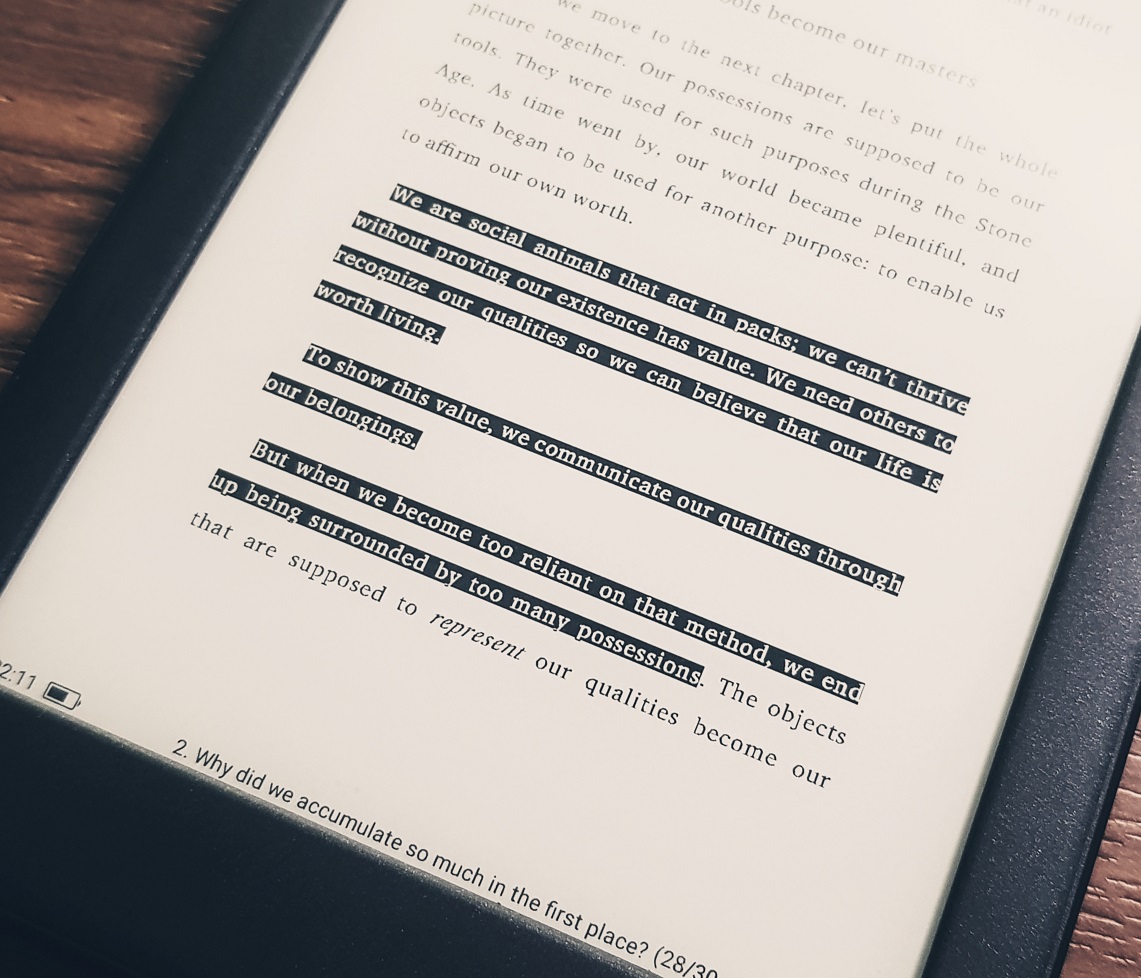
* This short essay was written while I was reading the book Goodbye, Things: The New Japanese Minimalism by Fumio Sasaki .
Thank you for reading my article!
Kim,