The Power of Compound Interest
If you truly want to achieve financial freedom, compound interest is a concept you must understand . Grasping and knowing how to apply the compound interest formula will help you build projection models for setting financial goals and business valuations in investing.
In this article, I will share various perspectives on compound interest. Along with that, visual and concrete examples will be provided to help you easily grasp the concept of compound interest as well as its positive and negative impacts on personal finance.
This article includes the following sections:
1, Introduction to compound interest
a, Compound interest formula
First, let's go over the general formula. Don't worry if you don't understand it right away; I was also confused the first time I saw it. However, seeing is believing—specific visual examples in the subsequent sections will make it much easier to understand.
Here is the dry formula we have (it looks intimidating, but it's actually quite simple 😁):
A = P * (1 + r) t
Where:
-
A - The final amount of money you receive
-
P - The principal amount you save/invest
-
r - The interest rate per compounding period
-
t - The number of compounding time periods applied to interest rate r
b, Practical examples of compound interest
Through the first section of the article, you have been introduced to the compound interest formula. To help you better understand its meaning and application, I will present a basic yet highly practical example.
The context of the example is as follows:
-
You have $1,000 in capital (P = $1,000)
-
You identify an investment opportunity with a return rate of 10%/year (r = 10% = 0.1)
-
You decide to invest for 5 years (t = 5 ⇆ corresponding to 5 interest periods, where each period is 1 year)
-
Your investment method is reinvesting both principal and interest .
This means you use $1,000 in capital invested at an interest rate of 10%/year → after 1 year, you receive $1,100 ($1,000 principal + $100 interest).
After receiving $1,100, you do not withdraw any money but continue to reinvest the total amount you have (reinvesting both principal and interest) → after the next 1 year, you receive $1,210 ($1,100 principal + $110 interest).
And by continuing to reinvest continuously like that, we get the figures in the table below.
| Year | Beginning Capital | Interest Earned | Ending Balance |
|---|---|---|---|
| 1 | $1,000 | $100 | $1,100 |
| 2 | $1,100 | $110 | $1,210 |
| 3 | $1,210 | $121 | $1,331 |
| 4 | $1,331 | $133 | $1,464 |
| 5 | $1,464 | $147 | $1,611 |
Explanation of the numbers in the table:
-
Beginning Capital = Ending Balance of the previous year
-
Interest Earned = Return rate (here 10%/year) * Beginning Capital
-
Ending Balance = Beginning Capital + Interest Earned
Finally, plugging the numbers into the compound interest formula , we get:
A = P * (1 + r) t = 1,000 * (1 + 0.1) 5 = $1,610.51
Thus, after 5 years from an initial principal of $1,000, if you reinvest continuously with a compound interest rate of 10%/year, you turn that amount into $1,610.51 (rounded up to $1,611 in the table).
2, The power of compound interest
Einstein once said: "Compound interest is the eighth wonder of the world. He who understands it, earns it... he who doesn't... pays it!" .

So let's explore what the power of compound interest is, and why seasoned investors consider it the most powerful (and most dangerous) financial leverage tool!
a, Positive impacts
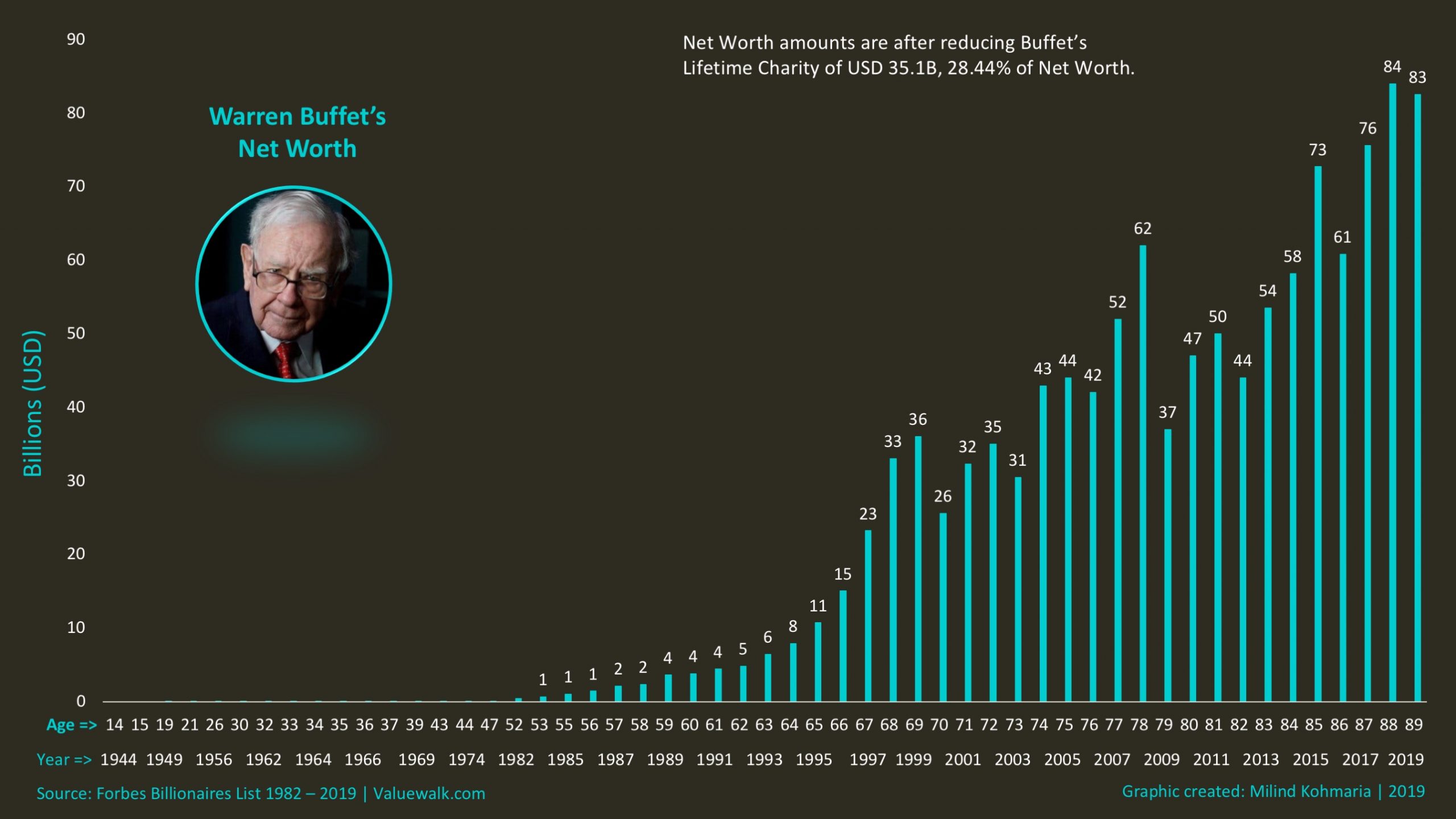
First, let's look at the positive side. Compound interest possesses immense power to help you turn a small amount of money into a massive fortune over time.
Consider the specific calculation of the two financial choices below:
-
Option 1 - Receive $1,000 each year.
-
Option 2 - Receive only $1,000 in the first year and earn 10% compound interest in subsequent years.
The chart above displays the growth of money between the two options. Looking at Year 20:
Total amount from Option 1 after 20 years = 20 * 1,000 = $20,000
-
Total amount from Option 2 after 20 years = 1,000 * (1 + 0.1) 20 = $6,728
We can see that during the initial years, the linear accumulation option yields much higher performance than compound interest, with Option 1 producing nearly three times the amount of Option 2. However, if we look over a longer timeframe, specifically 40 years:
Total amount from Option 1 after 40 years = 40 * 1,000 = $40,000
-
Total amount from Option 2 after 40 years = 1,000 * (1 + 0.1) 40 = $45,259
By this point, the money generated by Option 2 has surpassed Option 1. More impressively, just 10 years after this milestone, Option 2 yields double the amount of Option 1:
Total amount from Option 1 after 50 years = 50 * 1,000 = $50,000
-
Total amount from Option 2 after 50 years = 1,000 * (1 + 0.1) 50 = $117,391
Thus, in the early years, compound interest seems to show very little impact. However, once accumulated over a sufficiently long period, the growth momentum of compound interest becomes explosive.
To help you feel the growth momentum of compound interest even more clearly, I'll add a 3rd option to the comparison chart:
- Option 3 - Receive only $1,000 in the first year and earn 12% compound interest in subsequent years
Just like the 10% compound interest option, the 12% option doesn't show much difference in the early years. However, looking at the long run, we can see that Option 3 creates a significant gap compared to the first two options:
- Total amount from Option 3 after 50 years = 1,000 * (1 + 0.12) 50 = $289,002
The amount from Option 3 after 50 years is nearly 3 times that of Option 2 and nearly 6 times that of the first option. Incredible, isn't it? - And this is precisely how the wealthy build their vast wealth.
b, Negative impacts
The essence of compound interest is amplifying the growth of accumulated value over time . This means that if a negative impact is amplified by compound interest, the severity of that negative impact will lead to disastrous consequences.
In finance, there are two major negative impacts of compound interest that we commonly encounter:
Mismanaged debts
For mismanaged debts, it is similar to the scenario we discussed in the section on positive impacts of compound interest , except instead of money earned, it represents money you must repay.
Take this specific example:
You borrow an amount of $1,000 at an interest rate of 10%/year . Typically after 1 year, you would have to pay back $1,100 ($1,000 principal + $100 interest). But if you fail to manage your debt repayment and delay it for 20 years, do you know how much money you will owe them?
The amount you would have to pay is 1,000 * (1 + 0.1) 20 = $6,728 → meaning you have to pay nearly 7 times the original amount you borrowed.
In reality, that is a loan with a relatively low interest rate. If you owe credit card debt with an average annual interest rate of up to 40%/year , the amount you would have to pay back is 1,000 * (1 + 0.4) 20 = $836,683 .
Yes! You read that right. You would have to pay back an amount 837 times larger than what you borrowed from the credit card. And thinking a bit further, if you couldn't even pay $1,000 on time, how could you ever pay back nearly one million dollars?
This is why so many people get trapped in a debt spiral they can never escape. They only focus on daily interest figures. These numbers are just a few small bills, so they become complacent and assume they can live carelessly with those debts. But over time, interest compounding on interest amplifies the debt, and by the time they realize it, regret is far too late...
Therefore, to avoid letting debt destroy your personal financial plans, always remember to carefully plan your debts and always ensure you have an exit strategy before taking on any debt .
And if you cannot control your financial game yet, it's best not to touch debt at all!
Inflation

Besides mismanaged debt, inflation is also considered a silent parasite eroding your assets over time.
These inflation parasites are very unique. They operate like ravenous parasites, silently consuming most of your wealth over time without leaving a single trace for you to notice their presence ...
Inflation is the loss of purchasing power of money over time. A simple example people often use is buying a bowl of pho—a few years ago a bowl cost 30,000 VND ($1.15), but today it costs 50,000 VND ($1.92).
The bowl of pho still has the same amount of noodles, beef, and broth, so why is it more expensive? It's not more expensive because the quality went up, but because the money we spend every day is losing value!
Typically in Vietnam, inflation is kept stable around 4%/year - meaning our everyday currency loses 4% of its purchasing power each year.
Thus, 40 years into the future, a sum of $1,000 (26,000,000 ₫) today will only hold a purchasing value of 1,000 / (1 + 0.04) 40 = $208.29 (5,415,540 ₫) → which is only about 1/5 of its original value.
And do you know that in the past, during times of global financial instability, when inflation persisted at 10%/year , how many times that $1,000 sum lost value after 40 years?
The answer is 1,000 / (1 + 0.1) 40 = $22.10 (574,600 ₫) → Meaning your principal wealth was eroded by inflation to nearly 1/50th of its value!
Imagine how heartbreaking it would be if the wealth you accumulated over decades of your life was completely eroded by inflation...
That is why we should never leave money sitting idle; we must always invest it into assets capable of appreciating. Sometimes investing is not about making massive profits, but a way to protect decades of hard work from currency devaluation!
3, How to harness the power of compound interest?
In previous sections, I explained in detail what compound interest is, why it holds such tremendous power, and why it is the most vital tool in finance.
In this section, applying it to our reality, I will outline methods to help you harness compound interest to grow your wealth.
Before diving into each specific method, let's review the general formula of compound interest:
A = P * (1 + r) t
From the above expression, we can see that compound interest consists of 3 input variables:
-
Principal amount ( P )
-
Return rate per period ( r )
-
Number of compounding periods ( t )
This implies that if you want the final amount ( A ) to be as high as possible, you will need to optimize the variables above through concrete actions that I will discuss below.
a, Save and invest as much as possible
The first variable you can easily adjust is the principal amount ( P ). This variable represents the money you allocate to savings/investments. The action to modify this variable is simple and straightforward:
If you allocate more money to save/invest, you will reach your financial goals faster in the future.
A simple statistical chart below helps visualize the power of accumulation:
With an annual return rate of 6%, if you set aside $1,000 (26,000,000 ₫) to invest each year, after 50 years you will have:
1000 * (1 + 6%) 0 + 1000 * (1 + 6%) 1 + 1000 * (1 + 6%) 2 + ... + 1000 * (1 + 6%) 50
\[= \mathbf{\sum_{i=0}^{50} 1000 \times (1 + 6\%)^i}\]
= $307,756 (8,001,656,000 ₫)
I'm demonstrating plugging numbers into the formula just this once; by now you probably know how to use the compound interest formula . So feel free to plug in your own numbers for calculation!
However, if you are more determined and allocate more money to investing, specifically $3,000 (78,000,000 ₫) per year, after 50 years you will receive up to $923,268 (24,004,968,000 ₫).
b, Invest as early as possible
The second variable you can easily influence through action is time ( t ). This variable plays a core role in compound interest, helping turn an ordinary sum of money into extraordinary wealth. You can understand this method as follows:
If you invest earlier, you not only shorten the time needed to reach your financial goals, but you also gain the opportunity to far exceed your targets thanks to the greatest financial leverage tool in existence.
The statistical chart below illustrates the power of time leverage when investing early:
With an annual return rate of 6%, if you start investing $1,000 (26,000,000 ₫) per year right now (in 2025), after 50 years (in 2075) you will have $307,756 (8,001,656,000 ₫).
Conversely, if you wait until 2045 to start investing $1,000 (26,000,000 ₫) per year, by 2075 (30 years later), you will only receive about $83,802 (2,178,852,000 ₫).
c, Enhance knowledge to invest at higher return rates
The final variable you can influence is the return rate ( r ). Unlike the previous two variables, this one is very challenging to change.
To achieve a higher return rate, you must identify investment opportunities that generate extraordinary returns. And to do this, you must thoroughly understand financial rules and patiently track hidden opportunities that very few can see.
If you want to increase your return rate, you must patiently cultivate financial investment knowledge. In return, the reward for this process is immensely worthwhile.
The following chart illustrates the rewards you can reap if you dedicate effort to learning and investing at higher return rates:
By investing $1,000 (26,000,000 ₫) each year over 50 years at a 6%/year return rate, you will accumulate $307,756 (8,001,656,000 ₫). Not bad at all, right?
But look at what happens if you put in the work to master investing and achieve a consistent 15%/year return rate: the amount you receive back becomes a mind-boggling $8,300,374 (215,809,724,000 ₫)—166 times your initial capital!
And remember, I conservatively used only $1,000 (26,000,000 ₫) in annual capital. Imagine if you consistently set aside thousands or tens of thousands of dollars to invest each year over a long period: the wealth accumulated after 50 years would be beyond imagination! 🐎!

4, Applications of compound interest
a, Discounting future cash flows to the present
Discounting future cash flows to the present value is an important principle in finance, used to determine the current worth of money to be received in the future. The primary reason for discounting is the time value of money - a dollar received today is worth more than a dollar received in the future because:
-
Inflation - future money is eroded by inflation, making it less valuable than current money
-
Risk - future cash flows are uncertain (projections may carry errors), requiring discounting to reflect risk level
-
Opportunity cost - current money can be invested elsewhere for returns; calculating future returns of an investment must account for foregone opportunities
Through discounting, we can evaluate the true value of investments more accurately to make sound financial decisions.
In financial calculations, compound interest is used to discount future returns to present value using a discount factor , based on the formula:
\[PV = \frac{FV}{(1 + r)^n}\]
Where:
-
PV : Present Value of future cash flows after discounting.
-
FV : Future Value of cash flows.
-
r : Discount rate (or expected interest rate).
-
n : Number of periods (usually years or months depending on the problem).
Suppose you expect to receive 100 billion VND ($3,846,154) 5 years from now. Assuming annual inflation is around 10%, the discount rate will be 10%/year. Thus, the present value of that future 100 billion VND ($3,846,154) is:
\[PV = \frac{100}{(1 + 0.1)^5} = \frac{100}{1.61051} \approx 62.1\ \text{billion VND}\ (\$2,388,462)\]
So 100 billion VND ($3,846,154) 5 years from now is only equivalent to about 62.1 billion VND ($2,388,462) today when discounted at an inflation rate of 10%.
Example 2:Suppose you project a business's earnings over the next 3 years to be 100 billion VND ($3,846,154) per year. Additionally, you have other investment opportunities with a 15% return rate, so you set a 15%/year discount rate for this business. The present value of your projected cash flows is:
\[PV_1 = \frac{100}{(1 + 0.15)^1} = \frac{100}{1.15} \approx 86.96\]
\[PV_2 = \frac{100}{(1 + 0.15)^2} = \frac{100}{1.3225} \approx 75.13\]
\[PV_3 = \frac{100}{(1 + 0.15)^3} = \frac{100}{1.5209} \approx 65.23\]
\[PV = PV_1 + PV_2 + PV_3\]
\[PV = 86.96 + 75.13 + 65.23 \approx 228.32\ \text{billion VND}\ (\$8,781,538)\]
Thus, a cash flow of 100 billion VND ($3,846,154)/year over the next 3 years is equivalent to about 228.32 billion VND ($8,781,538) today when discounted at a rate of 15%.
Bottom lines
Through this article, you now understand what compound interest is and how immense its power truly is. Although it is a simple formula, it plays a role in nearly every financial calculation.
Furthermore, you have learned that in reality, the principles of building wealth and achieving financial abundance boil down to three simple actions:
Save and invest as much money as possible.
Invest as early as possible.
Enhance financial knowledge to invest at the highest return rate possible.
However, do not mistake simple for easy . While the actions are simple, very few people in this world have the discipline to stick with them over a long period.
Human wealth is hindered by many temptations in life. Therefore, besides acquiring knowledge, you must temper your resolve to truly achieve prosperity.
And that remains a long journey we all need to walk.
➝ Read next: articles in the personal finance series to equip yourself with essential financial knowledge and skills!
Thank you for reading my article!
Kim,