Building a Personal Finance System
As mentioned in the article What is Financial Freedom? , financial freedom leads to many other forms of freedom. It serves as a launchpad that makes it easier for us to pursue our dreams and live a meaningful life. To achieve financial freedom, just like solving a mathematical problem, we need concrete methods and actionable steps.

Having explored this topic through dozens of books, blog posts, and research studies by leading global wealth management experts, I have synthesized and summarized the key steps to set up a personal finance system that I apply to myself.
To summarize, my personal finance system consists of the following 7 steps:
-
Step 1 - Set up a personal expense tracker
-
Step 2 - Set up financial goals
-
Step 3 - Build an Emergency Fund
-
Step 4 - Pay off all debts
-
Step 5 - Build a Sinking Fund
-
Step 6 - Build a Personal Investment Fund
-
Step 7 - Spend on personal wants
Note: To achieve the best results, you should follow these steps in sequential order without skipping any step.
Step 1 - Set up a personal expense tracker
a, What is a personal expense tracker?
A personal expense tracker is a record of all your income and expenses over a specific period of time.
With the recorded data, we gain an overview of our cash flow and overall financial health across different periods (typically monthly). From there, we can easily adjust and plan our money management to achieve our desired financial goals.
b, How to set up a personal expense tracker
First, record all income and expenses incurred during the month in an Excel spreadsheet.
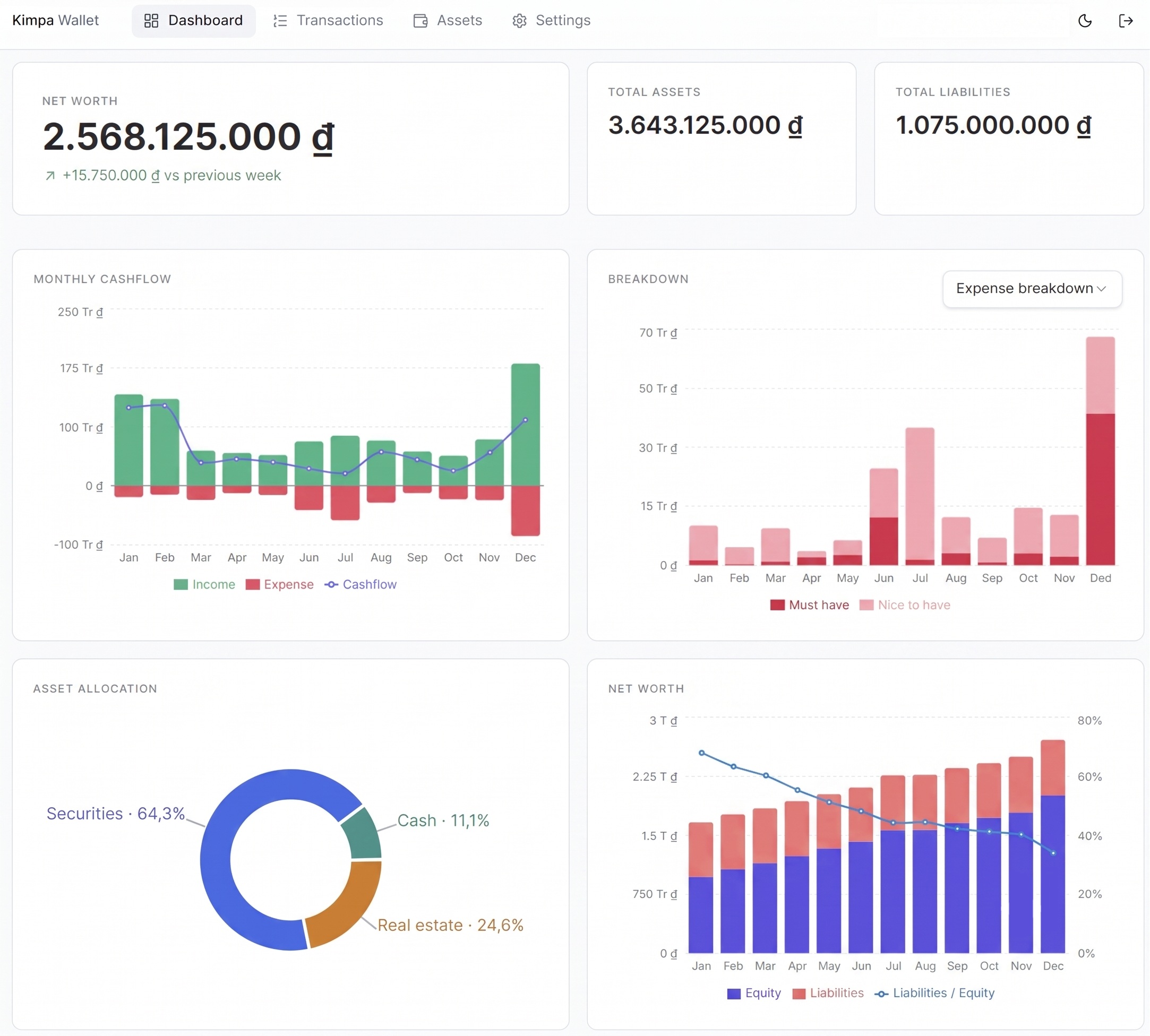 If you use a financial management app, it will be even more convenient. I built my own personal finance app,
Kimpa Wallet
, to record and display financial data according to my needs. You can
try it out here
and use it if you like.
If you use a financial management app, it will be even more convenient. I built my own personal finance app,
Kimpa Wallet
, to record and display financial data according to my needs. You can
try it out here
and use it if you like.
Once you have a full list of transactions for the month, categorize your expenses into two main groups:
-
Must-have expenses: These are essential expenses that you must pay each month to survive or those that bring significant future value. Examples include rent, utilities, food, transportation, Internet, debt payments, and learning new skills.
-
Nice-to-have expenses: These are discretionary expenses that bring a little joy or value to yourself or society. As the name suggests, having them or not won't significantly affect your basic living needs. Examples include charitable donations, gifts, loans to friends, shopping, and Netflix subscriptions.
Next, categorize your income into two main groups:
-
Steady income: This is your primary and regular monthly income. It includes your salary or predictable monthly revenue from your main business operations.
-
Other income: These are unexpected or variable sources of income. Examples include work performance bonuses, side project earnings, investment returns, loan repayments from friends, or gifts/allowances from parents.
By tracking and categorizing income and expenses, you gain a clear overview of your monthly financial situation. Try to maintain this habit consistently over time to get a complete picture of your financial standing. This is the first and most crucial stepping stone for gathering data, laying the foundation, and planning for your financial goals.
→ Read more in the detailed post Setting Up a Personal Expense Tracker .
Step 2 - Set up financial goals
a, What are financial goals?
A financial goal can simply be understood as the amount of money you want to accumulate within a specific timeframe. This is a critical part of the financial freedom journey because it answers the core question:
Without clear goals, people often adopt the financial benchmarks of those around them. But as we all know: Other people's goals are set to serve their desires, not ours .
Therefore, setting clear personal financial goals helps you define your unique financial roadmap. This allows you to focus your resources on achieving key financial milestones, turning your dreams into reality without losing motivation on an endless path with no destination.
b, How to set up financial goals
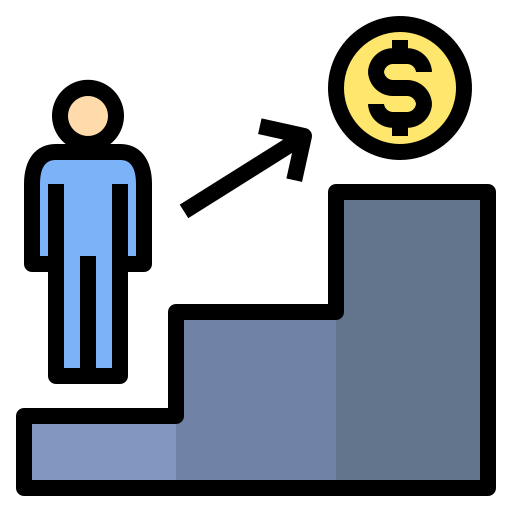
Break your financial freedom journey down into smaller milestones to track your progress, plan better for each stage, and most importantly, stay motivated as you move forward.
Here are 3 key milestones on the path to financial freedom:
First Goal - Financial Security
Financial Security is the state in which you have enough wealth to cover your essential living expenses (Must-have expenses) for the rest of your life.
This means that once you reach Financial Security, even if you were laid off tomorrow and remained unemployed indefinitely, you wouldn't have to worry about hunger, thirst, or homelessness.
However, keep in mind that achieving Financial Security only ensures basic survival, not necessarily the comfortable lifestyle you desire.
Second Goal - Financial Independence

Financial Independence is the state in which you have enough money to cover not only your essential survival needs but also discretionary expenses that make life comfortable (Must-have + Nice-to-have expenses).
Unlike Financial Security , reaching Financial Independence allows you to enjoy life's comforts, such as dining out, shopping, watching movies, and grabbing coffee with friends.
At this stage, you enjoy a relatively comfortable and fulfilling life. However, if you have grander aspirations, you may want an additional milestone to help realize your biggest dreams.
Ultimate Goal - Financial Freedom

This is the highest level of financial wellbeing one can achieve. In this state, you can live life entirely on your own terms, backed by sufficient financial power to bring your boldest dreams to life.
There is no fixed formula or exact figure for this goal because everyone's dreams are different. Some people need very little money to fulfill their desires, while others need billions of dollars to fuel their ambitions.
Regardless, rest assured that once you reach Financial Independence , you will know exactly how to calculate your personal target figure for Financial Freedom .
→ Read more in the detailed post Setting Financial Goals .
Step 3 - Build an Emergency Fund
a, What is an Emergency Fund?
An Emergency Fund is a financial safety net set aside for unforeseen emergencies such as job loss, sudden illness, or major home and vehicle repairs.
As its name suggests, an Emergency Fund acts as a financial shield protecting you against life's unexpected setbacks.
b, How much money should be in an Emergency Fund?

Financial experts generally recommend saving enough to cover 3 to 6 months of essential living expenses (Must-have expenses).
Personally, I prefer maintaining an Emergency Fund equal to 12 months of essential living expenses. I strongly advise individuals with variable or unpredictable income streams (such as freelancers) to target this 12-month benchmark as well.
As explained in Step 1 , your essential living expenses (Must-have expenses) cover basic survival needs. This includes rent, utilities, food, transportation, and healthcare. To determine an accurate figure, set up a personal expense tracker and record your cash flows over several months.
c, How should an Emergency Fund be managed and used?

First, keep your Emergency Fund in a separate bank account. Isolating this money prevents the temptation of accidentally spending your safety net on non-essentials. Remember: this fund must never be touched for anything other than genuine life emergencies.
Second, the Emergency Fund must be held in highly liquid assets. High liquidity ensures you can quickly convert funds to cash when urgent situations arise. In Vietnam, where financial products like Certificates of Deposit (CDs) or corporate bonds can carry risk, saving your emergency fund in a high-yield bank savings account is often the safest choice.
Finally, replenishing the Emergency Fund must be your top financial priority. If an unforeseen event forces you to draw from your fund, prioritize restoring it to its target balance as soon as your situation stabilizes.
Before conquering financial milestones, ensure you build an Emergency Fund to safeguard your journey against unexpected life challenges!
Step 4 - Pay off all debts
a, Why do you need to pay off all debts?
Debt is a financial leverage tool. Like any tool, it has both advantages and serious risks.
When managed with solid knowledge and risk control, debt can accelerate your path to financial goals. However, it can quickly turn into a deadly trap for anyone who lacks financial literacy yet chooses to play around with financial leverage.
For most people, debt is difficult to master. Paying off all debt is equivalent to reclaiming complete freedom over your life.
It provides peace of mind and saves significant amounts of money on interest payments, freeing up cash flow to pursue your financial goals.
Keep in mind that debt and inflation are two of the most dangerous threats in finance. Read more in the articles on The Negative Impact of Debt Amplified by Compound Interest and What is Compound Interest? for deeper insights!
b, How to handle and pay off debts
First, always prioritize paying off debts with the highest interest rates first. Generally, debt repayment priority should follow this order:
High-interest loan sharks → Credit card debt → Bank loans → Loans from friends → Loans from relatives.
If paying high-interest debts like loan sharks , credit cards , or bank loans is overwhelming, consider refinancing by borrowing from friends or relatives at zero interest to pay off high-interest loans first. However, while friends and family are often the first to extend help, approach this carefully: unfulfilled commitments can severely damage trust and personal relationships.
Finally, you can use your Emergency Fund to settle high-risk debts if necessary. As noted earlier, your Emergency Fund is designed for urgent emergencies—and eliminating dangerous, high-interest debt fits that definition in critical circumstances.
Step 5 - Build a Sinking Fund
a, What is a Sinking Fund?

A Sinking Fund is money set aside for specific major life plans and upcoming large expenses.
Major life goals might include buying a home, getting married, traveling, investing in higher education (like a master's degree), or upgrading essential work tools (such as laptops or phones).
b, How to use a Sinking Fund

Using a Sinking Fund is straightforward: create a plan → calculate the total budget needed → save up the required amount incrementally into your Sinking Fund.
Typically, a Sinking Fund is accumulated by setting aside a small percentage of your monthly income. Alternatively, you can allocate funds from your Investment Fund into your Sinking Fund when needed.
Step 6 - Build a Personal Investment Fund
a, What is a Personal Investment Fund?
As the name suggests, a Personal Investment Fund is capital dedicated to financial investments.
Building an Investment Fund serves two main objectives:
-
Protecting your purchasing power against inflation.
-
Accelerating your timeline to financial freedom.
Investing is not an optional luxury; it is essential for anyone aspiring to financial breakthrough and independence. Relying solely on earned income and cash savings leads to slow, linear wealth growth that is continuously eroded by inflation. Conversely, turning money into "financial soldiers" and deploying capital intelligently triggers compound growth—the master key to transforming linear savings into exponential wealth building.
b, How to set up and manage an Investment Fund
You should only build an Investment Fund using surplus cash left over each month after you have:
-
Covered essential living expenses (Must-have expenses)
-
Fully funded your Emergency Fund
-
Paid off high-interest debt
-
Allocated planned contributions to your Sinking Fund
Second, returns are directly tied to risk: higher potential returns carry higher risk. Even the world's most successful investors—such as Warren Buffett, Charlie Munger, and Bill Ackman—cannot guarantee a 100% win rate. Their long-term success comes from deeply understanding their investments, adhering to disciplined strategies, and executing rigorous risk management over decades.
Therefore, if you want to build wealth through investing, you must dedicate time and effort to mastering financial literacy and investment skills. Only by grasping economic principles and evaluating investment assets objectively can you effectively manage risk and increase your probability of success.
→ To learn more about sustainable investment mindsets and strategies, check out advanced articles in my Personal Finance series .
Step 7 - Spend on personal wants

Finally, because mental well-being is a vital asset worth investing in , you should allocate 5% to a maximum of 10% of your monthly income for personal enjoyment (Nice-to-have expenses) such as shopping or dining out.
→ Read more in the article Principles of Smart Consumption to avoid lifestyle creep—a common financial trap young adults face as income and standards of living rise.
Bottom lines
In this article, I have shared all the essential steps I use to structure my personal finance system. Below is a flowchart summarizing the process:
To continue on this journey, explore my detailed guides on each step in the Financial Freedom Article Series .
References:
-
And numerous books, blogs, and research papers on personal finance and the FIRE movement.
* Images used in this article are sourced from Flaticon
Thank you for reading my article!
Kim,