Safe Sex
In Vietnam, sexuality is becoming an increasingly complex topic. Integration with Western culture has led to significant shifts in how Vietnamese people perceive sex. It is no longer considered a strictly taboo topic, but is viewed much more openly. However, this is largely the perspective of the younger generation.
For previous generations, sex is still viewed as a private matter that should not be discussed within families or schools. This leads to adolescents lacking sexual health education because they are not properly guided and educated by their elders.
Moreover, when exposed to open sexual culture from the West, teenagers can easily be swept up by their desires and emotions, leading to sexual activity at an early age without protective measures for themselves and their partners, inadvertently causing uncontrollable consequences.
Here are several statistics that I gathered through research on the Internet:
According to a 2016 study conducted by UNFPA, approximately 17.4% of Vietnamese women reported having had an abortion in their lifetime.
Every year, Vietnam records around 200,000 to 250,000 abortions. Among these, unintended pregnancies account for 53.6%, and 60% to 70% of abortion cases are among students.
According to survey results from the Ministry of Health, the proportion of adolescents engaging in sexual intercourse for the first time before age 15 in Vietnam is trending upward. In 2016, this rate was 3.8%, but by 2022 it had risen to 5.4%. The rate of unintended pregnancies among adolescents is also increasing, from 2.8% in 2016 to 3.8% in 2022.
A lack of sex and relationship education not only damages physical health but also heavily impacts the future of the younger generation themselves.

Even though I did not receive formal sex education, I feel quite fortunate that I early on recognized the vital importance of this knowledge. Therefore, through self-directed research, I equipped myself with fundamental knowledge about gender and sexuality.
I am writing this article to summarize what I have learned. In addition, I also hope to spread this essential knowledge to many young people. In doing so, it can help our generation understand our bodies better and, further down the road, practice truly safe sex.
Because this is a "plug-and-play" post—meaning it is as concise and practical as possible rather than deeply academic—I will focus on answering two main questions:
1. When is the right time for first-time sex?
With cultural integration from the West, views on sex among the younger generation have become more open, and it is now regarded as one of life's basic needs alongside eating well or dressing nicely.
I have no issue with these changing views on sexuality among Vietnamese people. However, I believe we must ensure the following 3 factors before deciding to have sex :
a. Physical Health
Ensuring physical health means:
The body has fully developed.
No health aspect is adversely affected by engaging in sexual activity (such as underlying medical conditions).
Setting aside other aspects, having sex too early when the body is not fully developed (especially reproductive organs) exposes us to numerous health risks. At minor levels, it can lead to physiological dysfunctions or infections because mucosal membranes are still delicate; at severe levels, complications can cause infertility and even dangerous sexually transmitted diseases.
Furthermore, not truly understanding one's own body (such as underlying health conditions) might prevent us from anticipating all the consequences when engaging in sex without sufficient physical readiness.
Therefore, my best advice is: "Make sure you are of legal age (at least 16 years old) before having sex, and ideally at least 20 for men and 18 for women, because by then we can ensure that our bodies are fully developed and that we possess proper awareness regarding sexual relationships."
b. Mental Health
Ensuring mental health means that we:
Genuinely feel comfortable and willing to have sex.
Do not experience psychological distress or pressure when having sex.
That means if we still hold traditional beliefs about saving our virginity, or have undefined anxieties causing stress, guilt, and feeling unready for sex, do not rush into it. Take a pause to listen to yourself.
Sex is an activity that elevates emotional fulfillment and deepens happiness in love . Therefore, do not let reluctance ruin the wonderful things sex can bring or make you develop an aversion toward it.
What if we are not ready for sex, but our partner insists on it? — There are 2 things we must remember:
-
We always have the right to say no (even during sex) if we do not want to.
Someone who does not listen to and respect our feelings and thoughts is not someone worthy of our love. There are plenty of people out there who are far more deserving of our love.
c. Sex and Relationship Education Knowledge
In life, there are many things where we can proactively take trial and error to learn and accumulate experience. However, keep in mind that we can only afford trial and error when the consequences are controllable. When it comes to sex, the consequences left behind are often severe and cannot be easily resolved.

Therefore, equipping ourselves with sexual knowledge before having sex is vital to help prevent risks beyond our control .
Equipping ourselves with knowledge about gender and sexuality helps us:
Better understand our bodies and our partner's body.
Better understand our own emotions.
Prevent unintended pregnancies.
Prevent sexually transmitted infections (STIs).
Today on the Internet, there are many websites covering sex education that we can easily explore on our own. Here are some sexual health knowledge channels that I have followed:
2. How to have sex safely?
As mentioned in the previous section , we need to ensure 3 factors before actually engaging in sexual intercourse. Among those listed, equipping ourselves with sex and relationship knowledge is the most crucial factor .
In this section, I will share more detailed considerations to help us have sex more safely.
a. Finding a Suitable Partner
I always encourage each person to write down criteria defining the ideal qualities of someone they want to love . Not only does it help us find someone aligned with our values, but it also acts as a filter helping us screen out people with a high probability of carrying sexually transmitted infections.
* You can read my article about my ideal girlfriend profile here .
Some characteristics of what I consider a healthy relationship:
Compatible with us and ideally rooted in love.
Does not engage in sexual relationships with multiple people at the same time.
Can talk and communicate openly with us about sex.
And best of all, feels comfortable going together for STI screenings before both engage in sex.
What if we have not found a relationship we can trust, or feel we are not truly ready to have sex with someone else?
Stay calm, listen to, and respect your feelings. Sex is a personal matter that deserves respect. You should never feel pressured to have sex if you are not genuinely ready.
b. Combining Multiple Contraceptive Methods
Surely many of us already realize that using contraception during sex is very important . It helps prevent unintended pregnancies while also protecting us against sexually transmitted infections.
However, how to use contraceptive methods effectively is something not everyone knows. Below are important notes on using contraception so they can work properly and achieve higher efficacy.
First, always use condoms with someone you are having sex with for the first time to prevent unintended pregnancy and, more importantly, avoid sexually transmitted infections. According to a survey I conducted myself, the vast majority believe that we should use condoms when having sex in a new relationship for at least 6 to 12 months—long enough to deeply understand our partner.
Second, we should learn about common contraceptive methods and combine them together to boost contraceptive efficacy and reduce the transmission rate of STIs.
Here are several common contraceptive methods:
| Method | Effectiveness | STI Prevention |
|---|---|---|
| Withdrawal (coitus interruptus) | 50% | No |
| Calendar rhythm method | 70% | No |
| Condoms | 85% | Yes |
| VCF vaginal contraceptive film | 82% | No |
| Daily birth control pills | 95% | No |
| Emergency contraception pills | 90% | No |
| Intrauterine device (IUD) | 90% | No |
| Contraceptive implant | 99% | No |
| Contraceptive patch | 95% | No |
| Contraceptive injection | 96% | No |
As we can see from the comparison table, condoms are the only method among common protective options that can prevent sexually transmitted infections (STIs) . Therefore, I emphasize once again that we should always use condoms in new relationships, especially when we know little about our partner's health status .
Additionally, keep in mind that any contraceptive method is only relatively effective because it depends heavily on how we use it and external factors beyond our control. Thus, combining contraceptive methods is essential to enhance protection against unforeseen risks.
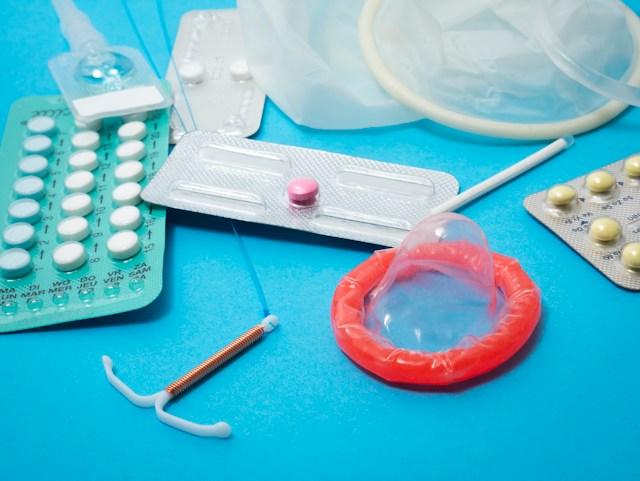
Here are some effective and safe combination strategies:
-
Condom + Withdrawal + Calendar rhythm method + VCF film : Always use condoms for every intercourse. In addition, track menstrual cycles to identify unsafe fertile days, and combine withdrawal + VCF film on those days.
-
Condom + Daily birth control pills (optionally combined with Withdrawal + Calendar rhythm method) : Always use condoms for every intercourse. Additionally, use daily birth control pills to add an extra layer of protection against condom failure risks (breakage, improper usage, etc.).
-
Similar to the combination above, but daily birth control pills can be replaced with other hormonal methods such as a contraceptive implant , contraceptive patch , or even contraceptive injections .
Which combination to choose depends on personal habits and our bodies. As mentioned at the beginning of this article, because this post does not provide deeply specialized medical instructions, please proactively research more information about the contraceptive methods you wish to use on the Internet to make the best choice for yourself.
Finally, always remember that emergency contraception pills serve as the ultimate backstop if a risk penetrates your protective strategies. However, emergency contraception pills cause many side effects for women, so we must never abuse them or use them as a routine method .
Bottom lines
In summary, this article has provided fundamental and practical knowledge on how to have sex safely.
I want to emphasize once again that this knowledge is vital because it protects us not only from health consequences but also safeguards our own future aspirations.
Although I know sex education in Vietnam remains a difficult topic to discuss openly and comprehensively due to cultural barriers, in today's era of modern technology, we can easily equip ourselves with sexual health knowledge via the Internet.
Take the initiative to arm yourself with this critical knowledge to protect your own future!
Thank you for reading my article!
Kim,