Reading Skills
I would not dare to claim myself as an avid reader who reads extensively. However, by reading 10 to 20 book titles each year, I have drawn several experiences for myself to read books more effectively.
Through this article, I will summarize and share my reading methods with everyone.
Before Reading
Step 1 - Define Your Reading Purpose
In archery, to hit the target accurately, archers must aim and calibrate very carefully before letting the arrow leave their bow. Reading books works the same way: we must determine our reading purpose before picking up any book.
If we randomly grab a book and devour it eagerly without being aware of the purpose behind that reading, it is just like picking up a bow and aiming blindly with our eyes closed . If we are lucky, we might hit a book containing the exact information we currently need; otherwise, it will be a huge waste of time and effort on something ineffective.
Furthermore, reading without a clear goal makes it difficult for us to finish any book. Over time, this will cause our passion for reading to fade away and waste the valuable knowledge that books offer.
Therefore, always try to define the goal you need to achieve before holding any book in your hands!
Step 2 - Select the Right Books

Currently, we can choose among tens of thousands of book titles across countless rich topics. So how can we choose the right book to read after defining our goal?
The answer is that we need to: Create a list of books related to your reading goal → Research an overview of each book's content → Select the book with the content best suited for yourself.
First, to create a list of books related to your reading goal , here are a few suggestions of book types you can include in your list:
Books that receive high praise and positive commentary from top experts in the field.
Books recommended or cited in a book of the same genre that you have previously read.
Books labeled as "best-seller" which are usually easy to read (because they are accessible, many people buy them → best-seller).
Books with great reviews on book review channels such as e-commerce platforms, book review communities, or Goodreads.
Next, to research an overview of each book's content , you can do what I usually do:
-
Read the foreword / introduction to know what topic the book is about.
-
Read the table of contents to grasp the main arguments presented in the book.
-
Read the reviews and editorial commentary to know who the author is, what kind of person they are, and whether the book is highly regarded.
-
Pick and read a few random short excerpts from one or two random chapters to see how the author explains and develops their main arguments.
Thus, after completing the two steps above, we have a list of books that we believe we should read. We have also grasped an overview of the content of the books on the list. Finally, whichever book has content most suitable for ourselves is the one we should choose to read.
Step 3 - Ensure You Truly Want to Read That Book

Actually, this step might feel a bit redundant for most people. Nevertheless, I still want to share an extra aspect I often evaluate before actually reading a book: Emotion .
Surely you already know that: When we truly love doing something, we will do it passionately without caring about time or fatigue .
Reading is no different. If we genuinely love the book we intend to read, we will easily complete it and absorb the knowledge much better. This is an aspect I pay close attention to before actually starting a book.
Make sure that the book you intend to read is a book you want to read , not just a book you need to read !
While Reading
After picking a book to read, here is how I approach reading it.
Step 4 - Choose the Appropriate Reading Method
Reading to Extract Ideas (Skimming)

This is the method of reading quickly and skimming to grasp the main key points . With this approach, we do not dive deep into arguments and evidence—the reasoning and explanations the author uses to clarify the core ideas—but focus only on the main key points.
Here are a few tips I often use for this reading method:
Hold the book slightly farther from your eyes and scan vertically down the page. You can use a pen to trace along the lines.
Do not re-read (also known as regression) if you miss a word or a piece of content.
If you wish to re-read, finish the entire chapter (or the whole book) first and re-read later.
Books I often apply this method to:
Fiction books / Novels.
Self-help books.
Biographies of entrepreneurs.
Books containing knowledge I already know (reading to recap).
Books that I am re-reading.
Reading to Understand (Deep Reading)

This is the method of reading slowly and deeply understanding the main arguments . With this approach, we will repeatedly read the reasons and evidence the author uses to clarify points we do not yet understand (sometimes these arguments reside in another chapter or even another book).
Here are a few tips I often use for this reading method:
Read until you fully understand.
Take notes directly in the book (directly engaging with knowledge, also known as active reading). I usually use 2 pens for taking notes: a highlighter and a ballpoint pen.
Maintain proper sitting posture in a well-lit environment because reading this way easily strains your eyes and back.
Choose a quiet place to maintain focus and perseverance.
Books I often apply this method to:
Academic / Non-fiction books.
Scientific papers and articles.
Books containing completely new knowledge.
Certain chapters of storybooks with great details (to ponder and visualize).
Combining the Two Reading Methods
When reading multiple books on the same topic, we can use the skimming method to quickly browse through sections we have already mastered, and use the slow reading method for new knowledge sections.
In addition, with any book, you can combine these two methods according to this strategy:
Use the idea-extraction method to quickly scan the entire book to get the main ideas, then use the slow-reading method to understand each part more deeply.
What If You Cannot Read Fast?
Then just read slowly! Everyone's ability to absorb knowledge is different, so you do not need to force yourself into a framework that you feel is ineffective.
Experiment for yourself to discover your best reading method, and never use anyone else as your measuring stick!
After Reading
There is a problem that almost everyone encounters: knowledge fading away after finishing a book. According to the forgetting curve by German psychologist Hermann Ebbinghaus, no matter how many great ideas a book contains, we tend to forget 80% of that knowledge after just 1 month.
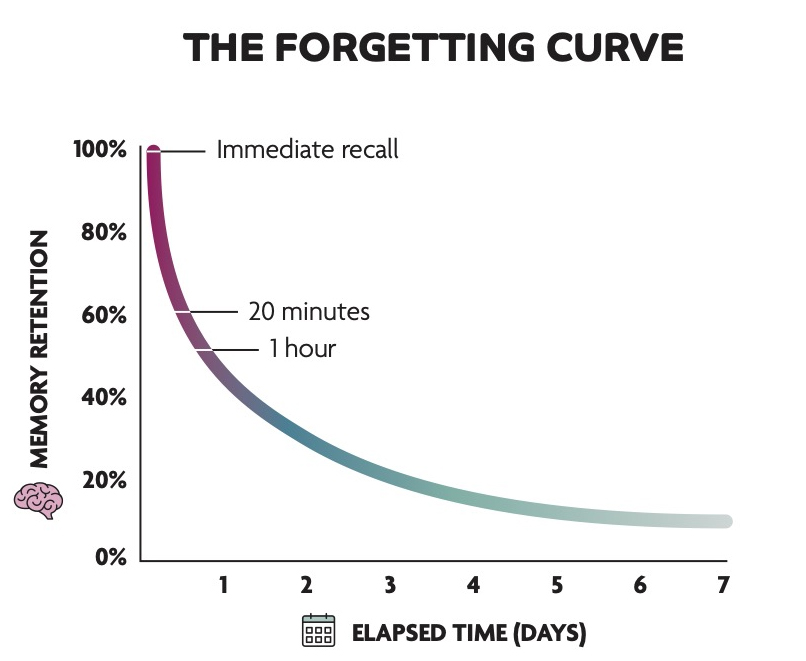
To overcome this issue, let me share a few activities I do after completing a book:
Step 5 - Extract Three Key Takeaways
Our brain is a miraculous masterpiece with a capacity larger than any hard drive in the world. However, its write speed is quite slow. Therefore, my method is simply applying the spirit of a minimalist:
A book can contain many wonderful ideas. However, if we try to tackle too many ideas at once, none of them will be executed thoroughly. Instead, focus only on the 3 takeaways you resonate with most and apply them right away in your life.
Once those 3 ideas prove effective in your daily routine, return to extract 3 new ideas and continue applying them. Taking it step-by-step like this will be far more effective and help you remember for much longer.
Tip: Use the table of contents as a map to easily navigate and find key ideas within the book!
Step 6 - Share What You Learned

Besides extracting key ideas, we should also share the book's ideas with anyone we can .
Sharing knowledge ranks among the most effective learning techniques. Every time we share, we review that knowledge once more. The more we share, the longer we remember.
Not only that, sharing is also a way to spread knowledge to the community around us. In return, people around us will also be willing to share back things we never knew before.
For me personally, this website is my way of sharing knowledge: both to spread insights and to review those learnings for myself.
Step 7 - Apply in Practice

Of course, learning must always go hand in hand with practice to be effective. Reading books is merely a way to enhance our personal knowledge. For that knowledge to be useful, we must apply it.
The reading and learning process does not end until you thoroughly understand every aspect of a problem.
Reading a book only gives you a direct view into a topic, whereas practical application truly gives you complete information through various perspectives. Finishing a book is not the end of acquiring new knowledge; finishing a book is the beginning of exploring different facets of the knowledge you just unlocked.
Bottom Line
Books are a very powerful "weapon". I hope that with the "tips" I shared in this article, you can master that potent and empowering weapon to some extent.
And as I mentioned, there is no single formula that applies universally to everyone. So be brave and discover the reading method that suits you best. I myself am still refining my reading skills day by day.
* Images in this article were taken from Flaticon
Thank you for reading my article!
Kim,