Passive Investing Method with Index Funds
Passive investing in index funds is an investment strategy that has been around for quite some time. Over time, this strategy has proven to be one of the safest and highest-performing investment approaches. That is precisely why I allocate a significant portion of my investment portfolio to this strategy.
In this post, I would like to note down and share what I know about this investment strategy.
This article includes the following sections:
An immutable rule in investing is:
Before allocating money into any investment, we need to answer at least these 3 questions:
-
What are we putting our money into?
-
Is the investment we are putting our money into safe?
-
Will the investment we put our money into generate profitable returns effectively?
Therefore, if this is your first time encountering this investment strategy, I advise reading through the sections of this post sequentially from top to bottom without skipping any details. If you are already familiar with the basic concepts and ideas of this strategy, you can jump straight to the section on steps to implement passive Index Fund investing .
Let's start with a few basic concepts.
1, What is an Index Fund?
According to the definition in the book The Little Book of Common Sense Investing by John C. Bogle:
An Index Fund is a basket (portfolio) containing many eggs (stocks) designed to mimic the overall performance of a financial market by tracking a market index (such as VN30 or S&P 500 ).
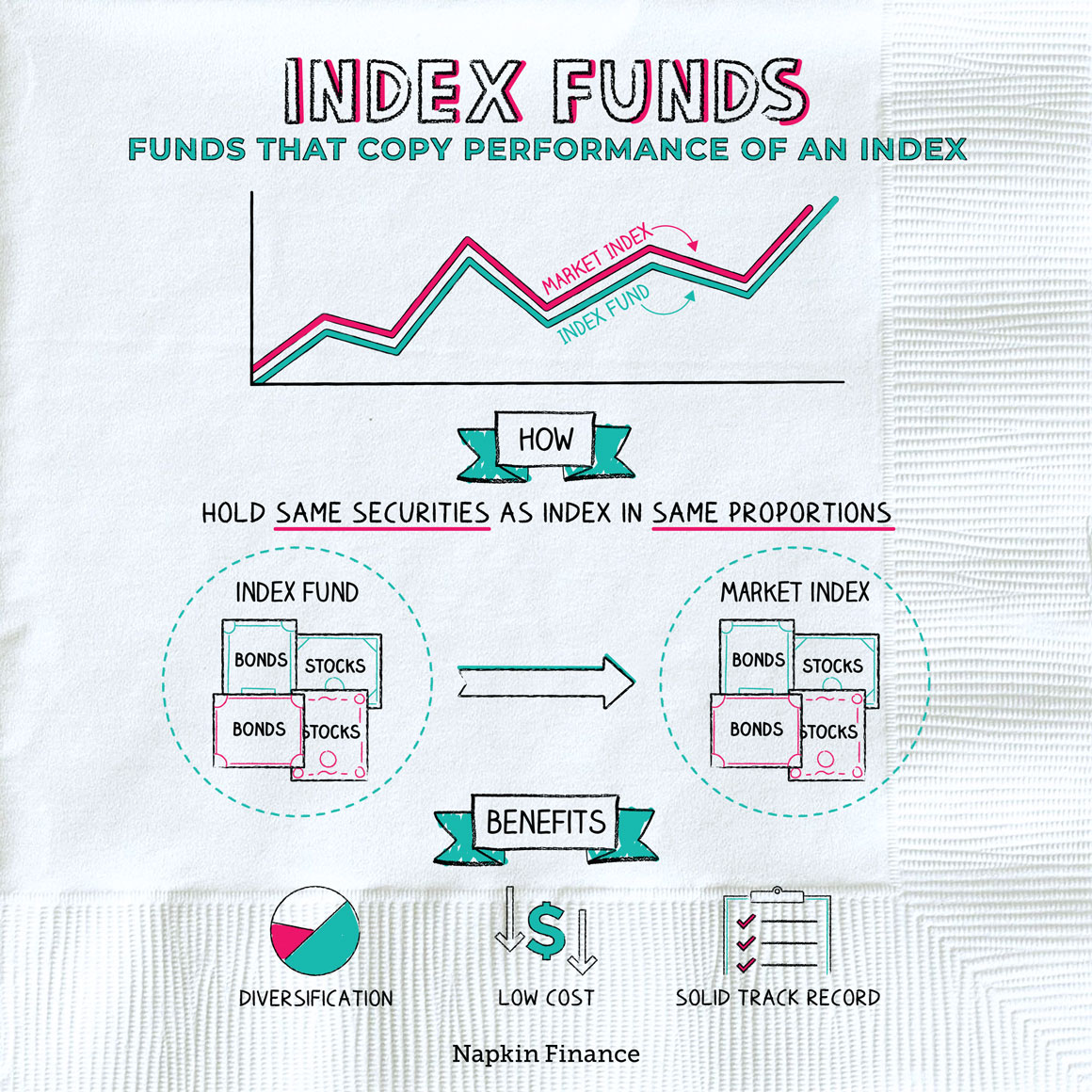
An easy-to-understand illustration of Index Funds by Napkin Finance
Because an Index Fund represents all stocks in the market, it eliminates the following 3 major risks:
Risk of individual stocks (bad/penny stocks)
Risk across different industries
-
Risk from poor choices by fund managers
The only risk an Index Fund faces is stock market volatility — which in practice actually serves as leverage to help us boost our returns when applying a passive investment strategy to Index Funds.
2, What is passive investing?
Active investing involves analyzing and selecting a few potential stocks to invest in to generate the highest possible returns in the short term. Typically, investors following this style aim to outperform the average market return.
In contrast, passive investing aims to minimize buying and selling (reducing incurred fees as much as possible) and hold all stocks across the market to achieve returns equal to the market average.
Advantages of passive investing over active investing :
-
Easy to execute: Compared to devoting time and effort to analyzing and picking out top-performing stocks, buying an Index Fund that represents the entire market is a much simpler and easier action for retail investors.
-
Low cost: Active investing involves buying and selling many stocks in the short term, incurring higher costs (brokerage fees and taxes) compared to long-term holding in passive investing. Moreover, if you invest in actively managed funds , management fees charged by fund managers are significantly higher than those of an Index Fund.
-
Beats most active investing methods: It is surprising to many that numerous statistics show Index Funds outperform Active Funds over the long term. This can be easily understood because, first, picking top-performing stocks consistently over a long period is extremely difficult; and second, taxes and fees for active investment strategies are much higher than those for passive Index Funds.
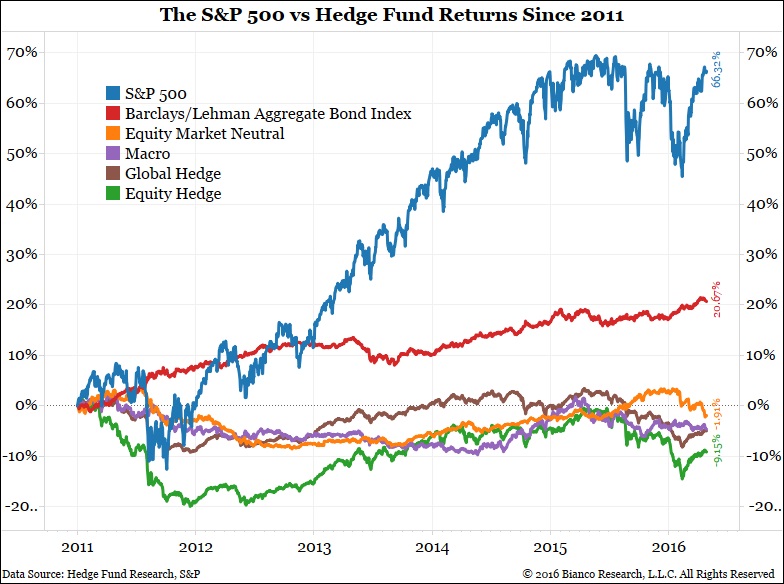
Here are some articles with statistics for further reading:
-
Active Vs. Passive And The Simple Reasons You Can't Beat An Index
-
Warren Buffett bet that hedge funds couldn't beat Index Funds
3, Reasons to passively invest in Index Funds in Vietnam
In Vietnam, the most popular Index Funds have portfolios weighted based on the VN-INDEX (or VN30) stock index . I believe that investing in these funds and holding them long term will generate strong returns for 3 main reasons:
a, High probability and growth potential
VN-INDEX is the benchmark index of the Vietnamese stock market. The stock market is always an effective barometer for an economy's health. So, what does Vietnam's economy have going for it?
Political stability in Vietnam.
Vietnam's financial system is managed relatively well (inflation is kept under control).
Vietnam has no major economic crises (wars or similar catastrophic events severely harming the economy).
Vietnam is a developing country (hence exhibiting higher growth rates than developed nations).
Vietnam enjoys a golden demographic period (an abundant and growing workforce).
Thanks to these positive economic prospects, I expect that:
-
The number of listed companies on the HOSE exchange will increase in the future.
The market capitalization of listed companies on HOSE will increase in the future.
Thus, total market capitalization of companies listed on HOSE has substantial room for growth → The VN-INDEX will rise accordingly → The returns on my investments in Index Funds tracking this index will grow accordingly.
b, Low risk
Furthermore, investing in Index Funds means I own a portfolio containing a wide variety of stocks, dominated by the market's top-performing companies — those with the largest market capitalizations.
As a result, my risk is well diversified. Even if a specific company performs poorly and goes bankrupt, I don't need to worry much because:
Bankrupt companies usually make up a very small percentage of the portfolio (since underperforming firms typically have small market caps).
My portfolio contains many other high-quality companies capable of carrying the underperforming ones.
During periodic portfolio rebalancings of Index Funds, underperforming companies are removed and replaced by better-performing ones → Weak companies are continuously weeded out periodically.
c, Very low costs of Index Funds
An Index Fund is a passive investment fund. Passive funds operate very simply without requiring a large management team, so operational costs are extremely low. As a result, the annual management fee for these funds is usually <1% NAV per year.
Combined with the power of compound interest , compared to active funds with annual management fees of >3%, over the long term (>20 years), I will save a massive amount of profits that would otherwise go to active fund managers — who often fail to beat passive funds over long horizons anyway.
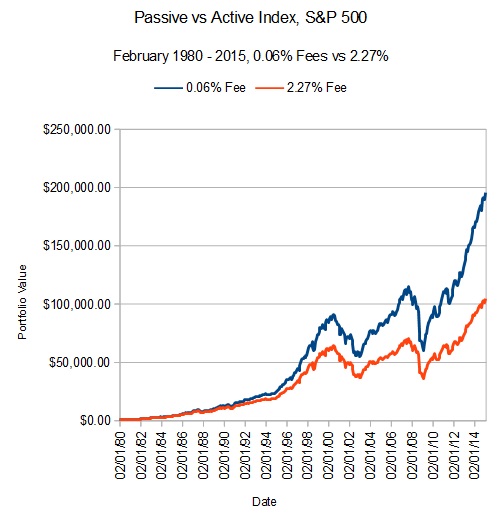
Over a 50-year period, statistics show average returns of active funds are only half of what Index Funds generate, largely due to the massive fees paid to fund managers.
4, Steps to implement passive Index Fund investing
The core idea of the Passive Index Fund Investing Method is simply:
Accumulate and hold.
Below are the detailed investment steps that I have been following:
Step 1 - Open a brokerage account at any securities company
Index fund certificates trade just like stock tickers. Therefore, you need to open a brokerage account.
My advice is to select securities firms with low transaction fees. I commonly use VPS and TCBS .
Compare transaction fees across Vietnamese securities firms here .
Step 2 - Go to the stock purchase section and select an Index Fund ticker
It is nearly impossible for an individual investor to buy every stock on the market and weight them according to index proportions.
Therefore, Index Funds do that work for us and divide their NAV (Net Asset Value) into equal smaller units called fund certificates for retail investors to buy (much like dividing a pizza into equal slices for everyone to share).
To buy certificates of these funds, simply go to the buy stocks section → enter the Index Fund ticker → purchase the desired quantity .
Recommended Index Fund tickers I frequently purchase:
FUEVN100 :
Portfolio of the top 100 largest market-cap stocks on HOSE.
Tracks 95% of the VN100 index and 85% of the VN-INDEX.
Management fee: 0.67% NAV/year.
-
See details here .
E1VFVN30 :
Portfolio of the top 30 largest market-cap stocks on HOSE.
Tracks 95% of the VN30 index and 80% of the VN-INDEX.
Management fee: 0.8% NAV/year.
-
See details here .
Step 3 - Allocate a fixed amount every month to buy your chosen Index Funds from Step 2
To maximize returns when investing in ETF Index funds, you should apply the DCA (Dollar Cost Averaging) strategy , which means:
Buy once a month on a fixed date (for instance, the 1st of every month). I often break this interval down further: purchasing once every Wednesday.
Use an equal amount of money for each purchase (for example, setting aside $115 per month to buy).
If this is your first time buying Index Fund certificates and you have a large lump sum, here are a few suggestions to deploy your capital appropriately:
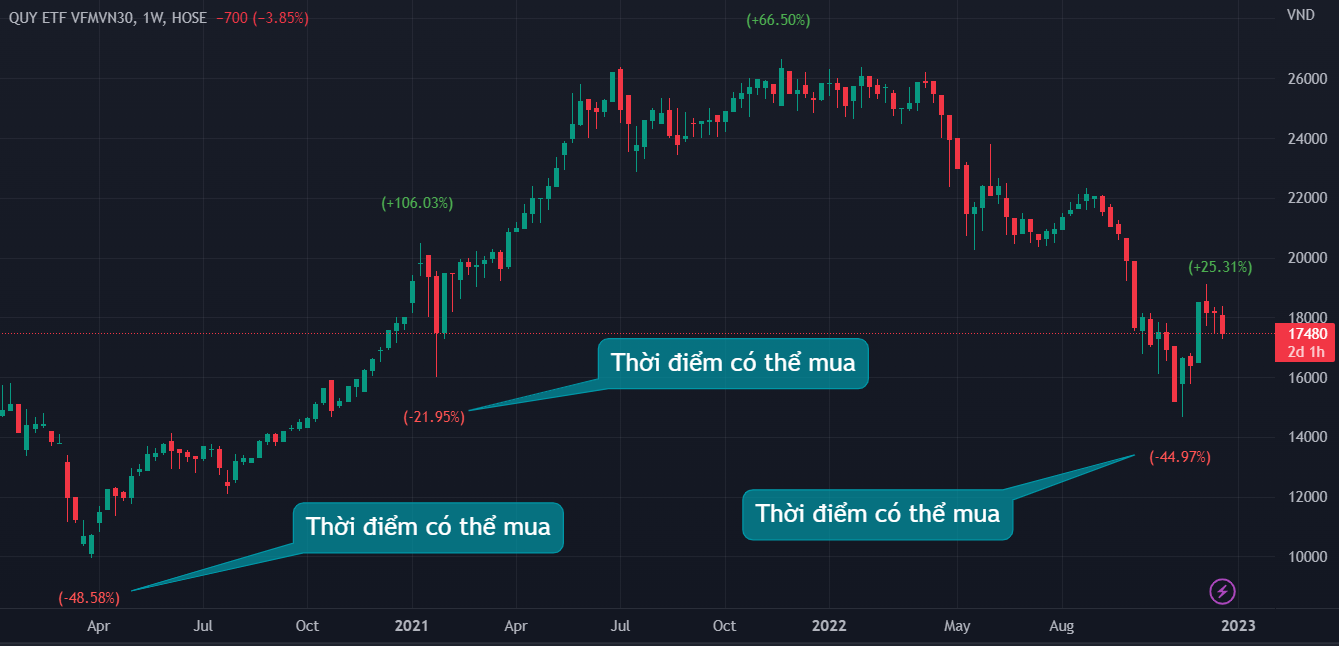
- Wait for major market drops of >20% in the VN-INDEX to deploy large amounts ( Lump Sum strategy ) : For example, if I have $3,850. If the VN-INDEX drops 20% — allocate $960 to buy. If the VN-INDEX drops another 10% — allocate another $960. If the VN-INDEX drops another 15% — deploy another $960. Whenever the VN-INDEX experiences a sharp decline, deploy a major portion of funds (I typically use 15–30%).
-
Break down the lump sum and deploy it gradually every month ( DCA strategy ) : For example, if you have $3,850, deploy $385 each month (fully deployed after 10 months). For undeployed funds, you can place them in a high-yield savings account to prevent inflation from eroding your purchasing power.
Combining both methods is also a great approach.
Step 4 - Turn off all notifications related to that investment
Human nature always desires to get rich quick.
Index Fund investing is not like that. It requires time to accumulate and compound returns (usually taking at least 2 years to see clear results). Therefore, proactively distance yourself from checking the investment frequently.
I once had a friend who, after hearing my advice, bought in right before the market dropped >15% (Jan 2021). Panicked, he sold off all his fund certificates right at the bottom and suffered heavy losses (despite my best efforts to reassure and stop him). Since he sold, up to now (Jan 2022), the market has surged >100%.
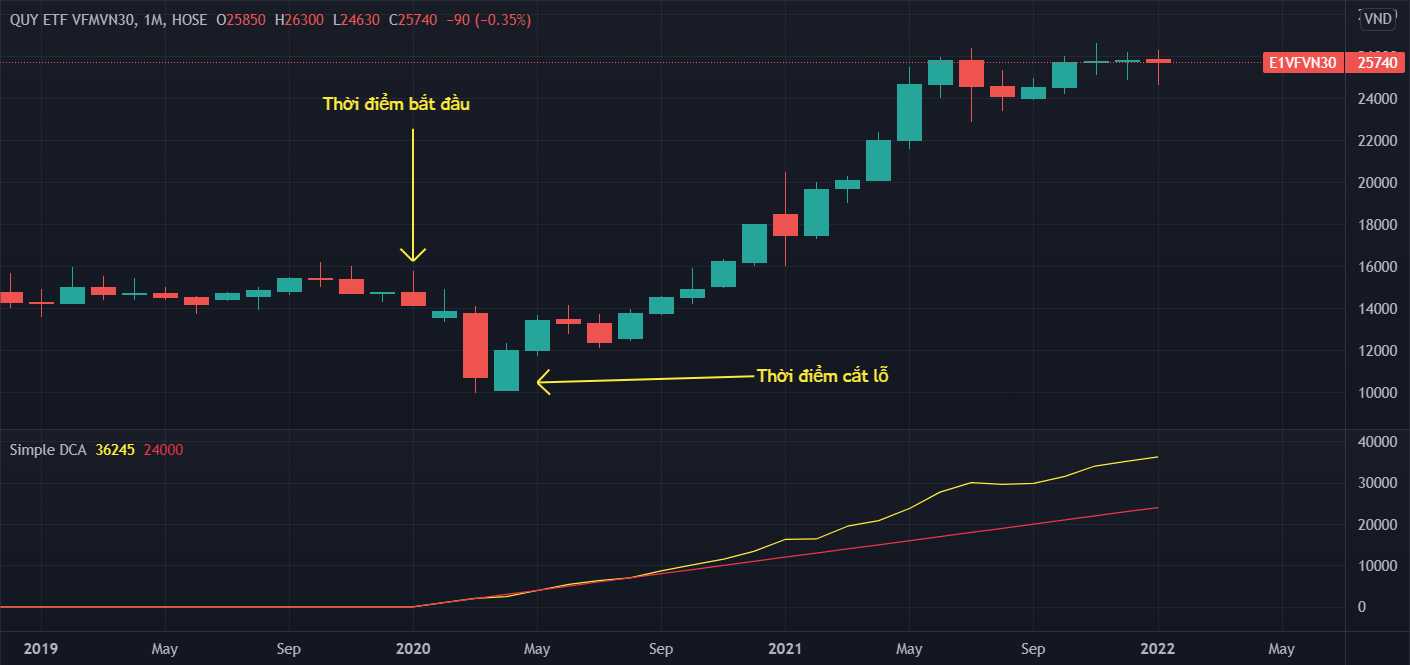
Investing is a mind game. If you haven't mastered your emotions, it's best to isolate yourself from the game!
5, Real-world results
a, S&P 500
The S&P 500 is an index tracking the market capitalization movements of the 500 largest publicly traded companies in the US.
Let's see what happens if I started investing in this index at the worst possible timing — the peak right before the 2008 financial crisis.
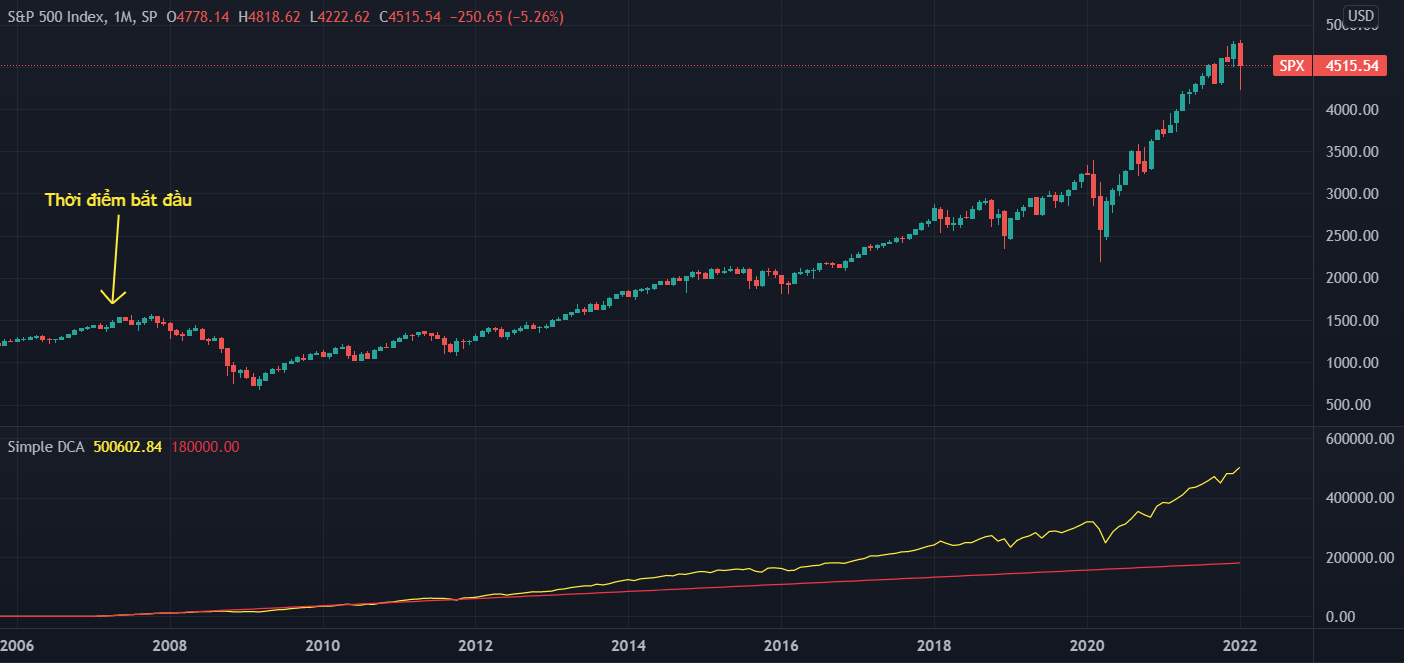
Input data :
Strategy: Set aside $1,000 every month to buy S&P 500 ETF Index funds.
Start time: Worst-case scenario — right before the 2008 crisis.
End time: Present — January 31, 2022 (total duration of 180 months).
Results :
Short-term (6 months after starting): The 2008 financial crisis wiped out 70% of the investment portfolio value.
Medium-term (2 years after starting): Broke even.
Long-term (present, 10+ years later): Investment value is over 2.5 times total capital invested (portfolio value reached $500,000 compared to total capital invested of nearly $180,000).
Compound Annual Growth Rate (CAGR): 9.1%
Let's look at the results if we apply the same strategy over a longer horizon — specifically over 50 years.
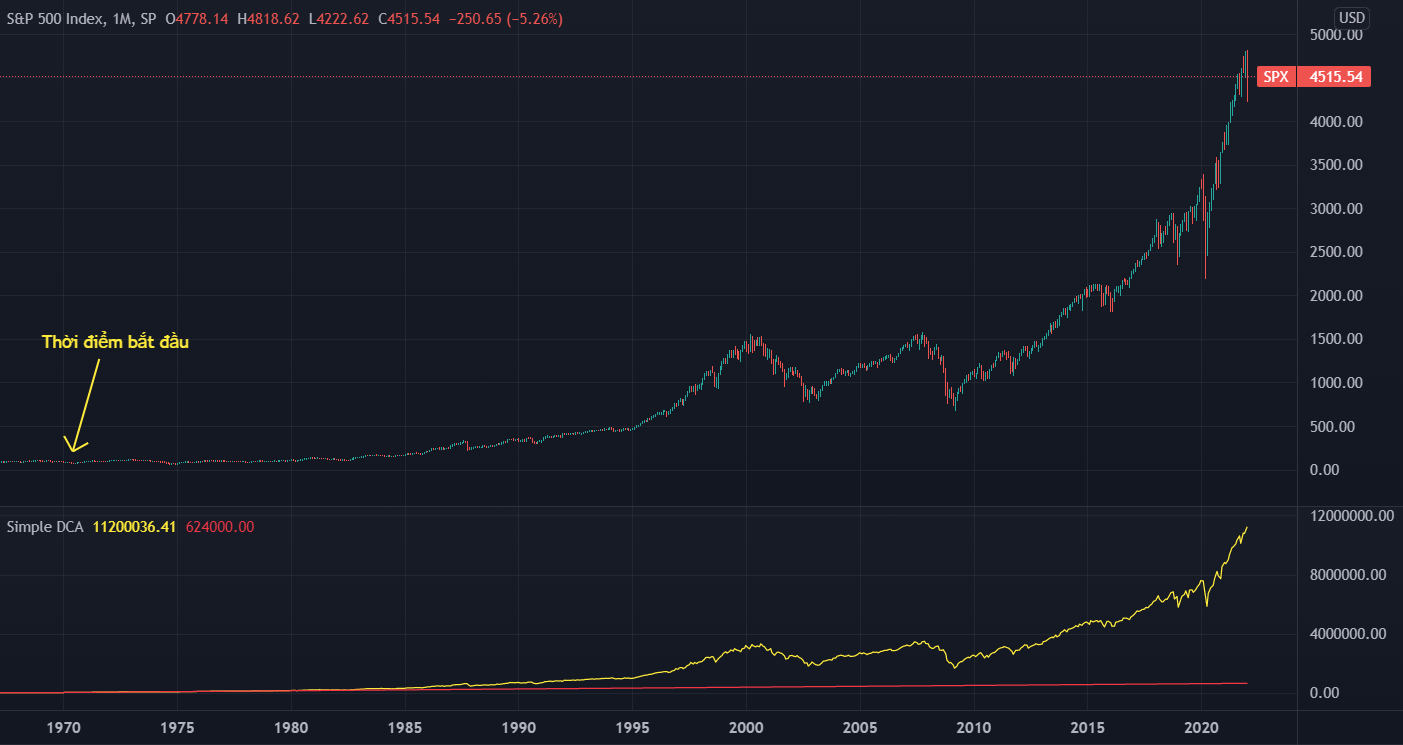
Input data :
Strategy: Set aside $1,000 every month to buy S&P 500 ETF Index funds.
Start time: January 1, 1970.
End time: Present — January 31, 2022 (total duration of 624 months).
Results :
Long-term (present, over 50 years later): Investment value multiplied 18 times compared to invested capital (portfolio value reached $11,200,000 while total capital invested was nearly $624,000).
Compound Annual Growth Rate (CAGR): 7.9%
b, VN 30
VN30 is an index tracking the market capitalization of the 30 largest companies on HOSE. This index closely mirrors ~85% of the VN-INDEX.
In the previous section, I mentioned E1VFVN30 . This is an ETF Index fund tracking the VN30 index. Let's examine the effectiveness of applying the DCA strategy to invest in this fund.
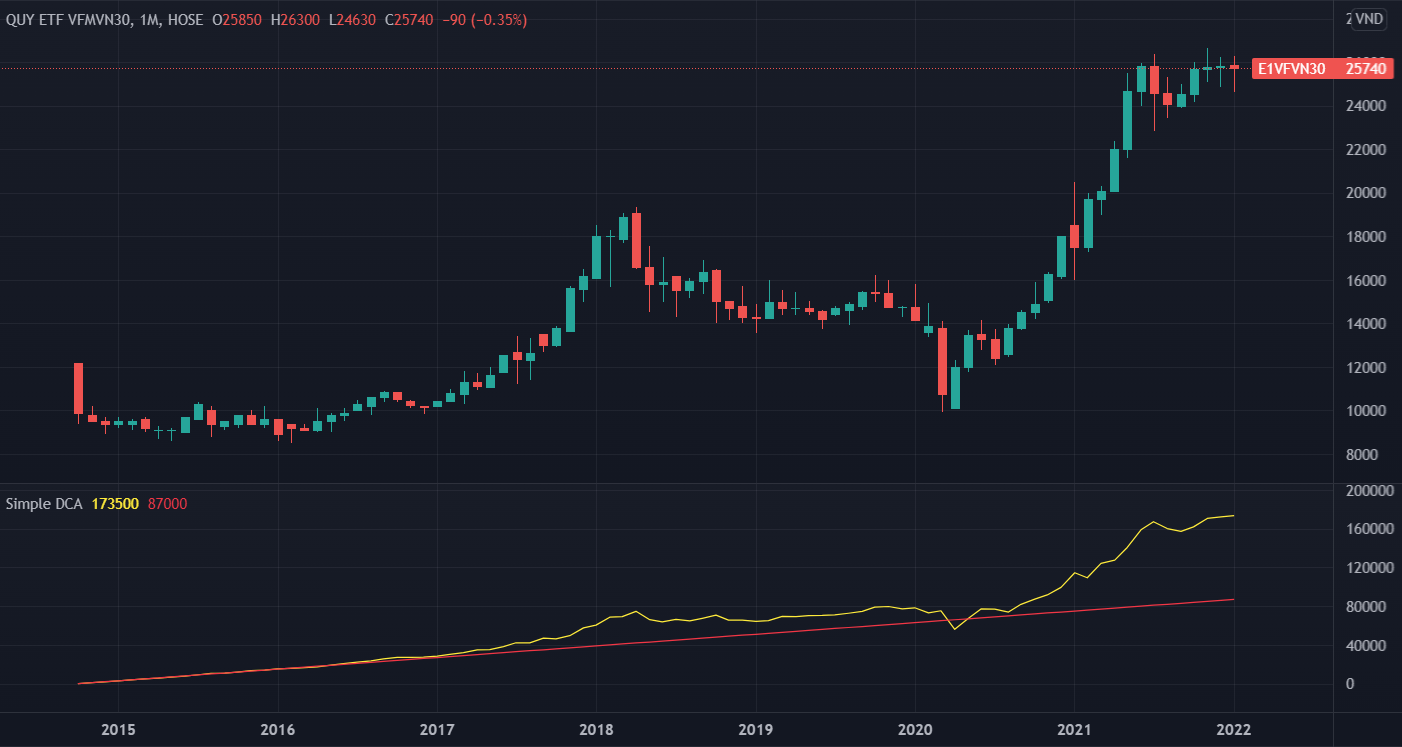
Input data :
Strategy: Set aside $1,000 every month to buy E1VFVN30 fund certificates.
Start time: The day E1VFVN30 was first listed (October 6, 2014).
End time: Present — January 31, 2022 (total duration of 87 months).
Results :
Short-term (6 months after starting): Market moved sideways → investment value = total capital invested.
Worst point (March 2020): Market dropped >30% due to COVID-19 pandemic. At this point, portfolio value = 80% of total capital invested.
Long-term (present, 6+ years later): Investment value doubled compared to total capital invested (portfolio value reached $170,500 compared to total capital invested of over $87,000).
Compound Annual Growth Rate (CAGR): 10.4%
Bottom lines
Through this article, I have shared with you the DCA strategy for passive investing in index funds. This is a very simple investment approach, yet its long-term effectiveness is remarkably high.
However, past performance patterns may not always repeat in the future. Therefore, combine this investment strategy with proper portfolio risk management to achieve truly sustainable profits.
Great articles for further reading :
Thank you for reading my article!
Kim,