Building a Personal Expense Tracker
Recording personal income and expenses is a simple action, yet it holds massive influence over the process of achieving financial freedom.
This practice provides us with essential data to gain a comprehensive overview of our financial health. From there, it allows us to clearly define financial goals and build an effective personal asset management system .
In this article, I will share my personal experience in recording and tracking cash flows.
1, Personal Expense Tracker Template
I used to rely on several expense tracking apps such as Money Lover, Misa, etc. However, none of them fully satisfied my personal workflow and requirements.
Therefore, I initially created a custom Google Sheet Template to record my income and expenses.
Currently, I use
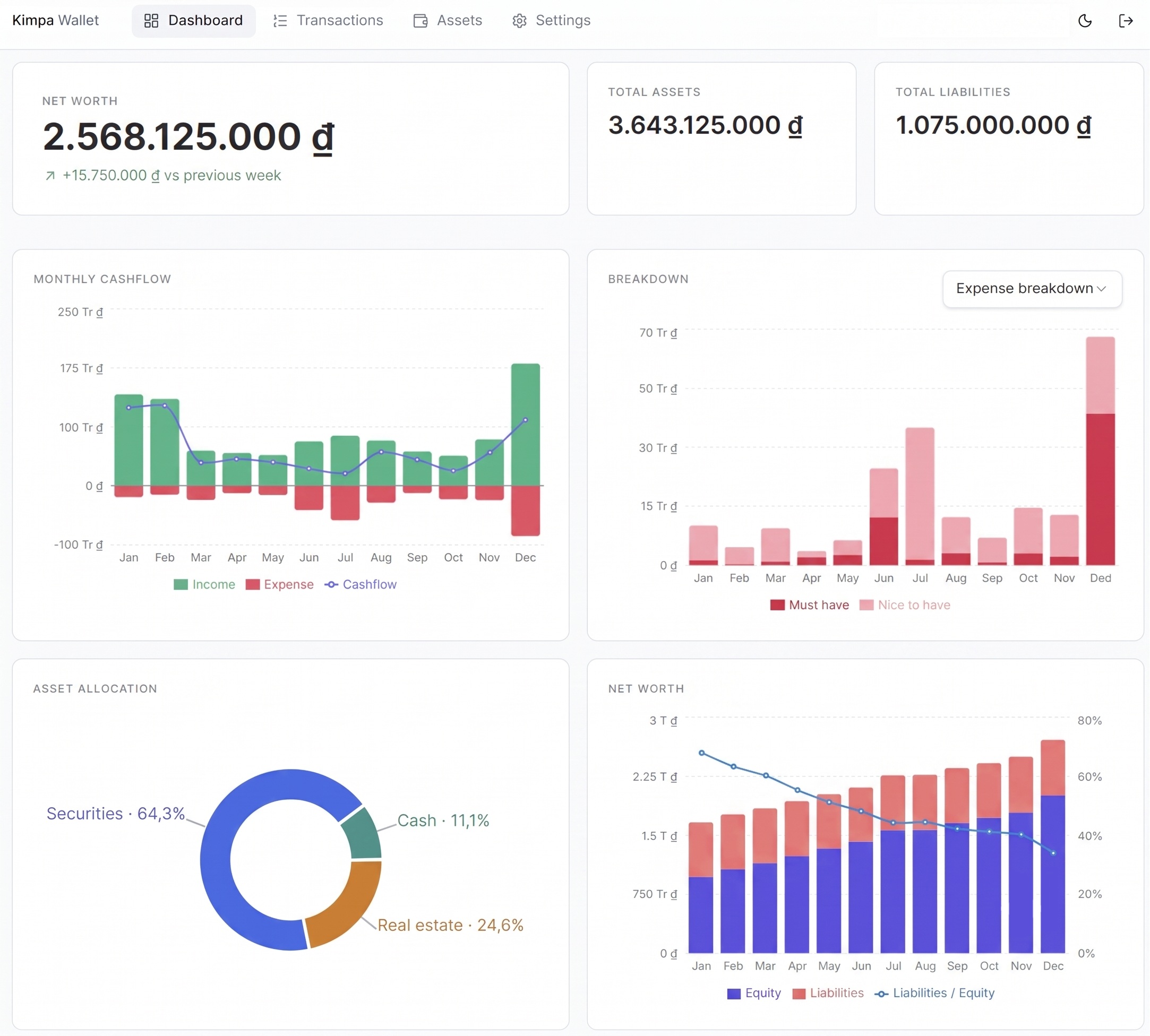
Kimpa Wallet
(a personal finance application developed by myself) to personalize the experience of recording and tracking personal cash flows. You can
try it out here
and use it if you like.
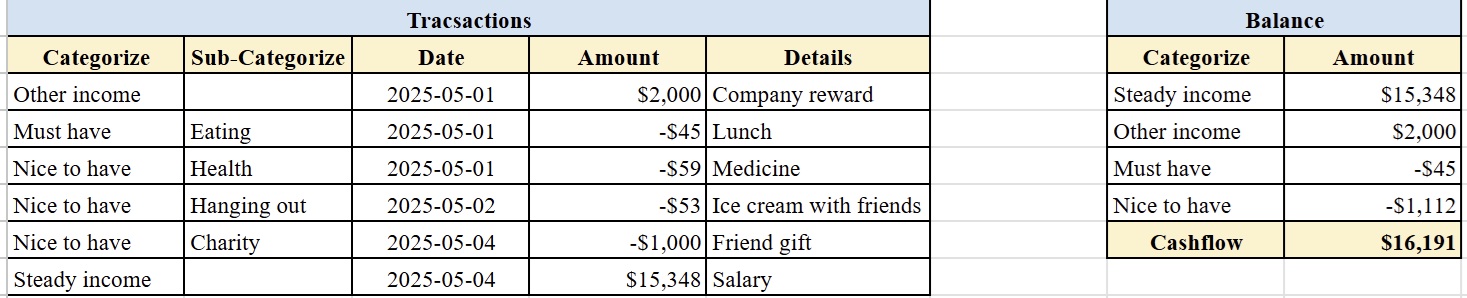
First, let's take a quick look at my tracking template, which consists of 2 main sections:
-
Transactions : The ledger recording all personal transactions during the month.
-
Balance : The financial summary table ( which simply sums up transaction values for each item from the Transactions ledger ).
Now, let's dive deeper into explaining the details inside the "Monthly Transaction Ledger - Transactions ".
2, Cash Flow Categorization
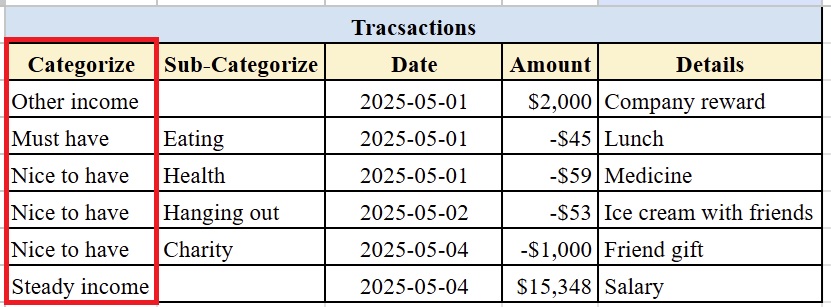
a, Outflow
This represents personal spending cash flow. I usually divide this flow into 2 categories:
-
Must-have expenses: These are essential expenses that you must incur each month to survive or those that bring high long-term value in the future. Examples include rent, electricity, water, food, transportation, Internet, debt payments, and learning new skills...
-
Nice-to-have expenses: These are discretionary expenses that bring joy or minor value to yourself or society. As the name suggests, whether you have them or not won't significantly impact your daily life. Examples include charitable donations, gifts, personal loans to friends, shopping, Netflix subscriptions...
b, Inflow
On the flip side, this represents personal income flow. I usually divide this flow into 2 categories:
-
Steady income: This is your primary and regular monthly income. It includes your base salary or stable income generated from primary monthly business operations.
-
Other income: These are unexpected or variable sources of income. Examples include work performance bonuses, side project earnings, investment returns, loan repayments from others, or allowances from parents.
Initially, I broke down expenses and income into numerous granular sub-categories. However, after tracking for a long period, I realized that overcomplicating a tedious task makes us lazy and drains the motivation to maintain habits. Therefore, I simplified my categories and found that these 4 core categories effectively cover 95% of my routine transactions.
If you are meticulous and want a detailed breakdown of every transaction, you can apply the Sub-categorization by Purpose method explained in the next section.
3, Sub-categorization by Purpose (Optional)
If you do not need granular details for every single transaction, feel free to skip this section. For those who prefer detailed records, classify transactions into 2 levels:
-
The primary level is Cash Flow Categorization covered above. It clarifies whether a transaction reduces money (outflow) or adds money (inflow).
-
The granular level is Sub-categorization by Purpose . It provides exact insights into where money went, its specific purpose, and the proportion of each spending item. Similarly, you gain full clarity on income sources and their respective weight.
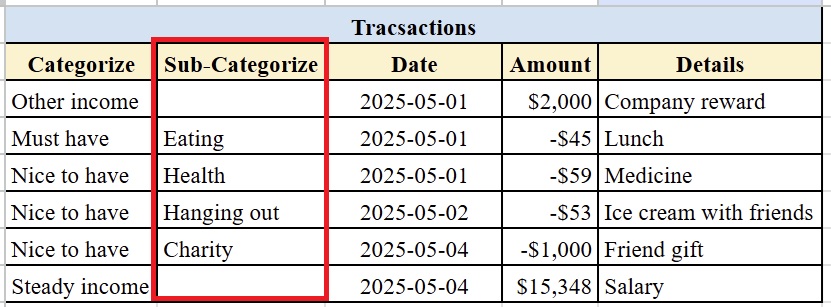
Here is an example of how I group transactions by spending purpose:
-
Eating: Expenses (typically must-have) related to food, groceries, and dining.
-
Household: Expenses (typically must-have) related to housing, such as rent, electricity, water, Internet, etc.
-
Transportation: Expenses (typically must-have) related to commuting, such as taxi fares, fuel, parking fees, vehicle maintenance, public transport, etc.
-
Health: Expenses (typically must-have or nice-to-have) related to healthcare, medical checkups, medication, skincare products, etc.
-
Education: Expenses (typically must-have or nice-to-have) related to learning, such as online courses, tuition fees, books, etc.
-
Charity: Expenses (typically nice-to-have) bringing value to yourself and society, such as birthday gifts, charitable donations, treating friends/colleagues on special occasions, etc.
-
Hanging out: Expenses (typically discretionary) for social and leisure activities like eating out, movies, and casual entertainment.
-
Shopping: Expenses (typically discretionary) to fulfill shopping desires.
-
Lend: Outflow items (nice-to-have) when lending money to others, or inflow items (other income) when borrowing money.
-
Payback: Outflow items (must-have) to settle existing debt, or inflow items (other income) when debtors pay you back.
In practice, everyone has unique financial circumstances and spending habits. Avoid sticking rigidly to my exact list; instead, use it as a reference framework and adapt it to your actual lifestyle.
4, Structure of Transaction Details
To ensure easy reference when reviewing records in the future, each entry should capture essential minimal data fields. Clear and detailed records make reviewing past financial data for personal financial planning significantly effortless.
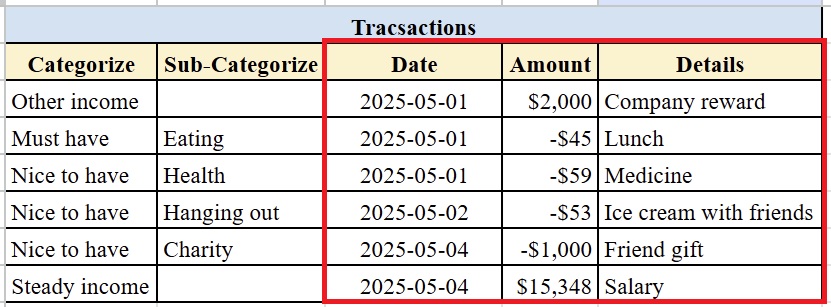
Here are the minimum required fields for every income or expense entry in my cash flow tracker:
-
Transaction Amount (Amount): The exact numerical figure involved in the transaction. Unquestionably, this is the most critical piece of information.
-
Transaction Date (Date): The exact date when the transaction occurred. While some record down to the hour and minute, tracking down to the day level is sufficient for me.
-
Transaction Notes (Details): Specific contextual notes worth retaining. For instance: "Treated Hoang to crab noodle soup."
As with previous points, everyone has preferred ways of logging notes. However, I consider these 3 fields the essential baseline for any transaction entry.
Bottom lines

In summary, tracking personal income and expenses is a straightforward and accessible habit. The more consistently and accurately you log transactions, the clearer your financial baseline becomes. This acts as a launchpad for establishing a robust personal finance system, accelerating your progress toward financial freedom.
The primary challenge of expense tracking lies not in the technique, but in consistency and persistence .
Most individuals struggle with financial management because they fail to maintain consistent tracking habits, leaving them unaware of where their money flows and unable to formulate actionable plans for specific financial goals. If you possess genuine motivation and belief in transforming your financial future, starting with a solid expense tracking system is the indispensable foundation!
→ Continue reading: Setting Up Financial Goals after gathering your personal cash flow data.
Thank you for reading my article!
Kim,