Value Investing Method

As mentioned in the article What is financial freedom? , if you want to achieve financial freedom early, you must start investing as soon as possible to leverage the power of compound interest in growing your wealth.
On the topic of investing, I wrote a dedicated post on the Passive Investing Method with Index Funds specifically designed for those with limited financial knowledge who still wish to invest with a moderate return at low risk.
In this article, I will introduce another classic investment strategy for those who are more ambitious and seek higher investment returns — value investing.
1, What is value investing?
Suppose one fine day, a somewhat "quirky" stranger offers to sell you a 500,000 VND ($19.23) banknote for only 10,000 VND ($0.38). Realizing this is an incredibly lucrative deal, you decide to pay 10,000 VND ($0.38) to get their 500,000 VND ($19.23) bill → That is value investing.

In short and plain terms: Value investing is an investment strategy based on buying assets priced lower than their intrinsic value.
Value investing is most commonly discussed in the context of the stock market, where Benjamin Graham first introduced it in his book "The Intelligent Investor," and where his student, Warren Buffett, applied it with extraordinary success throughout his career. In reality, however, beyond stocks, this method can be applied to almost every area of life.
-
In the stock market, if you buy a stock with an intrinsic value of 60,000 VND ($2.31) for only 20,000 VND ($0.77) — that is value investing.
-
In real estate, if you purchase a piece of land worth 4 billion VND ($153,846) for just 2 billion VND ($76,923) — that is value investing.
-
In personal life, if you invest 30 million VND ($1,154) to earn a professional certification because you know it will land you a salary of 50 million VND ($1,923) per month — that is value investing.
-
In marriage, if you invest love (time, care, affection, etc.) in a partner because you know they will bring happiness to your home — that, too, is value investing.
As you can see, value investing is not merely a financial technique; it is a mindset that helps us evaluate and choose to invest in things that bring genuine value to our lives.
2, How to apply the value investing method?
Today, value investing has gained widespread popularity, drawing interest from many investors and leading to an explosion of resources including books, articles, and videos. However, not all sources are truly reliable. Much of the available material simply rehashes core ideas with flashy terminology, making it difficult for readers to grasp the true essence of the approach.
Based on my personal experience and investment journey, I will outline my approach along with materials I consider "worth reading" to help us study and apply this investment philosophy effectively.
Step 1 - Cultivate knowledge
Before jumping into investing, we should equip ourselves with two essentials:
-
Basic financial knowledge
-
Investment mindset
In practice, investing does not require deep mastery of complex financial theories — those belong to academic researchers. However, to invest effectively, you must build a solid foundation of basic financial knowledge . This includes the ability to read and interpret financial statements, such as asset structure, income statements, and cash flows. To gain these fundamentals, pick up a textbook on financial statement analysis (I previously read the Financial Statement Analysis textbook from the National Economics University).
As for cultivating a value investing mindset, I recommend the following resources:
-
The book The Intelligent Investor by Benjamin Graham — Considered the bible of value investing, containing the foundational principles of the methodology. It is a "must-read" for fundamental investors.
-
The book Warren Buffett: The Making of an American Capitalist by Roger Lowenstein — Buffett is the most successful practitioner of value investing. Reading his biography helps us understand the personal traits an investor needs to succeed with this method.
-
Warren Buffett's annual letters to shareholders — An exceptional resource for sharpening investment thinking.
-
The YouTube channel New Money — Offers insightful analyses of videos featuring value investors. English speakers can broaden their investment mindset significantly here.
-
The YouTube channel Long-term Stock Investment (Đầu tư chứng khoán dài hạn) — The only channel in Vietnam I have found that strictly adheres to the value investing philosophy. I frequently reference case studies from this channel.
-
Additionally, reference books, podcasts, videos, and case studies from renowned value investors such as Charlie Munger, Joel Greenblatt, Seth Klarman, Peter Lynch, and others.
There are countless other resources available. However, in my experience, once you explore what I listed above, you will realize most other materials express the exact same underlying concepts using different words.
Therefore, once you possess the core value investing mindset, stop spending excessive time reading investment books; focus your time and energy on researching and analyzing real businesses (i.e., practicing) instead .
Step 2 - Build investment criteria
Every investor should establish their own set of criteria for selecting companies. These criteria serve as a filter to ensure we pick businesses aligned with our personal style while filtering out weak or risky operations.
We can build our customized investment criteria by:
-
Studying successful value investors (search online or review the materials recommended earlier)
-
Learning and reflecting on our own investing experience
You can review my company evaluation criteria in the article Business Analysis Method !
Step 3 - Analyze businesses
This is the most laborious phase for a fundamental investor , requiring extensive hours spent on what many might view as "dry" and "tedious" work — analyzing businesses.

Using the criteria defined in Step 2, business analysis involves thoroughly evaluating a company across multiple dimensions, such as:
-
Is the company's industry supported by broader economic trends?
-
Does the business model demonstrate sustainable earning power?
-
Is the company financially healthy?
-
Is the ownership structure balanced? Is executive management ethical and protective of shareholder interests?
-
Are company profits distributed fairly and wisely?
-
...
Each item requires gathering data and evaluating multiple facets. Because this is far from simple, investors must practice patiently to hone their knowledge and analytical skills over time.
Time permitting, I will share more of my personal business analysis framework in future posts.
Step 4 - Choose the right investment timing
Finally, after thorough analysis and selecting businesses that meet our criteria, wait patiently to enter a position when the company's market capitalization falls below our estimated valuation by a sufficient margin of safety (typically at least 20% below intrinsic value).
Always remember that a great company is not necessarily a great investment unless its market valuation is cheap enough to buy . Exercise caution and calculate the timing and price range before deploying capital.
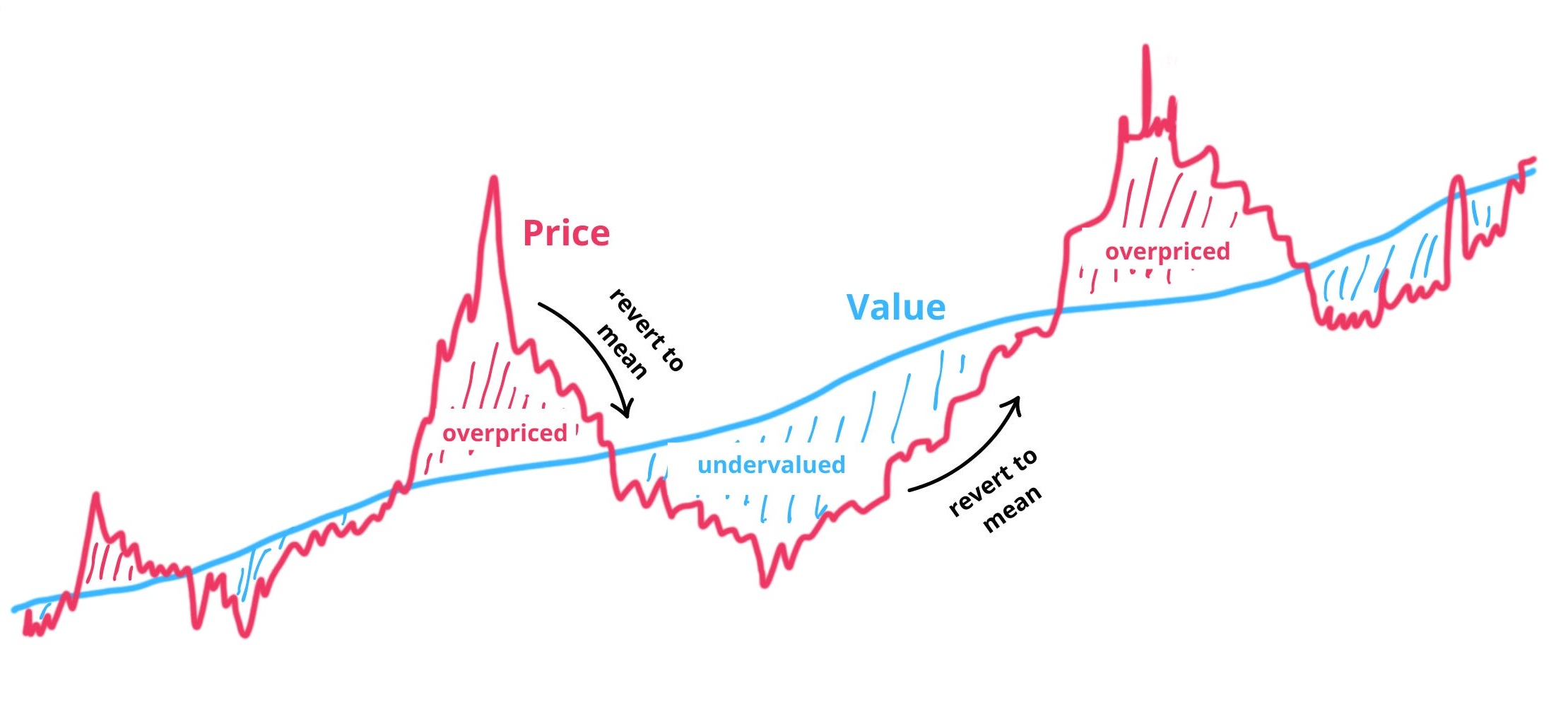
There will be periods when we must wait a long time for asset prices (stocks, real estate, etc.) to discount deeply enough. Maintain discipline and avoid losing patience — discipline is what protects your capital.
What should you do while waiting? Use that time to research other companies and maintain a watchlist of high-quality businesses, ready to act whenever market events cause quality assets to be sold at bargain prices.
Bottom lines
In this article, I have outlined the core concepts and practical steps to explore and implement the value investing philosophy in your investment journey.
Because this topic is vast, I will dive deeper into specific components — such as mindset, stock selection criteria, valuation techniques, and more — in future posts.
Thank you for reading my article!
Kim,
25/12/2024